

Block, the former tech darling, just laid off 4 in 10 people.
Here is Jack, the CEO/Founder, writing to this ex-employees:

I’ve been through enough of these layoffs now, both at barely Series A startups and at companies that had hit the funny horse with the forehead-corn.
This is the same thing that’s been happening at Amazon, at Meta, and at the long tail of startups that never make the headlines.
The whole industry is compressing and it can be very depressing.
I’ve really been there. And I’m sorry to hear it and see it.
I’m sorry. (I’m Canadian so I tend to say this a lot.)
So if we know that knowledge work (as it exists today) is all going the way of the Dodo bird1 to some extent, what is it that you can do today if you don’t know what’s gonna happen to your job and you also don’t know where to jump ship?

In the past, you could navigate choppy waters even if you’re not the perfect sailor. Eg. going from large companies to scrappier ones. Or from one role on the team to wearing different hats. Or from Individual Contributor to Manager.
Now the waters are all muddy.
Very muddy.
Part of the challenge is even framing and bounding what the problem is. And what makes it doubly worse is that it’s all happening oh so fast.
Prior cycles of technological change and upheaval happened over months to years, enough time for workers, managers, investors to react to it. Now we are talking days, if not hours.
Disruptive Innovation2 in tech used to happen like stalactites meeting stalagmites. Except for the run-off, it mostly had conservation of volume while changing “hands”. With a fundamental change like AI and all that it brings in both the first-order, second-order, and higher-order effects well, it’s not that you won’t think things will change, it’s that you no longer can be certain what would be the degree of change and there doesn’t seem to be a safe-harbour (particularly if you’re working in tech or any knowledge work for that matter.)
Let me give you a concrete example of what I mean by The End of Knowing.
Back in the 90s, there was this Canadian band. I say was, I guess they are still around. But in their heydays as a band, one of their more experimental albums was called Spiritual Machines3. They were inspired by a book, written by a computer scientist. A really shiny book cover. And since I liked the band, I bought and read the book.
This science dude already predicted that AI will come and also what day it’ll show up decades before. He called it the Singularity (as in the black hole kind) because everything gets sucked up into its gravitational pull.
(Sitting here in 2026, pretty sure he was right).
But as I’ve just illustrated, I’ve known about this for oh 30 years now. So have many many others including the Canadian Rock Band. So has this guy went on to do a stint at Google and now more people with their own opinions about when more advanced AI is coming.
But see that’s the point I’m trying to make — it’s not enough just to understand it, just as he understood that Moore’s Law would’ve gotten here one way or another.
Not only that, prior cycles were focused on a technological disruption, not necessarily a displacement (which this is, I would argue).
When “someone” else is much smarter and quicker than you in the room and it takes no time or upfront money to get them up to speed, what kind of threat is that?
That’s a tsunami (trigger warning) of the 4th kind.
Jack says it’s “structural.” (That’s one way to put it.)
Despite the difficulty for those tech workers affected and in making this one-way door decision, he dared to say this important, quiet thing out loud.
We’ve crossed the Rubicon.
Life for those working in tech will never quite be the same as it was since the 1980s. Heck, even circa 2020.
But not the same doesn’t mean a damn thing if you cannot really describe it fully, enough to know what the heck is going on beyond the headlines, beyond the near-term anxiety.
It doesn’t help that Citrini’s report4 was near-term prognostic and then the Block bomb dropped only days later to make it seem all too true. Funny time, ain’t it?
It laid out the potential doomsday scenario, but it still doesn’t give you a damn about what happens when we reach The End of Knowing.
Knowing that it’ll end doesn’t mean you know how it’ll end or where or why.
Nor does it tell you what to do about it.
So let me give it a go.
I promise you, I’m not trying to convince you of something that you don’t know. But as I’m writing this and have been pondering this for some time, I perhaps can offer a few nuggets of what I’ve been through, gone through, so that you can find some solace that there is a light at the end of the tunnel.
“The undiscovered country from whose bourn / No traveler returns” — Hamlet
When encountering high uncertainty, what can you do?
The first step is to admit that you don’t know.
That’s humility. Uncertainty should bring a proportionate amount of humility, if not even more.
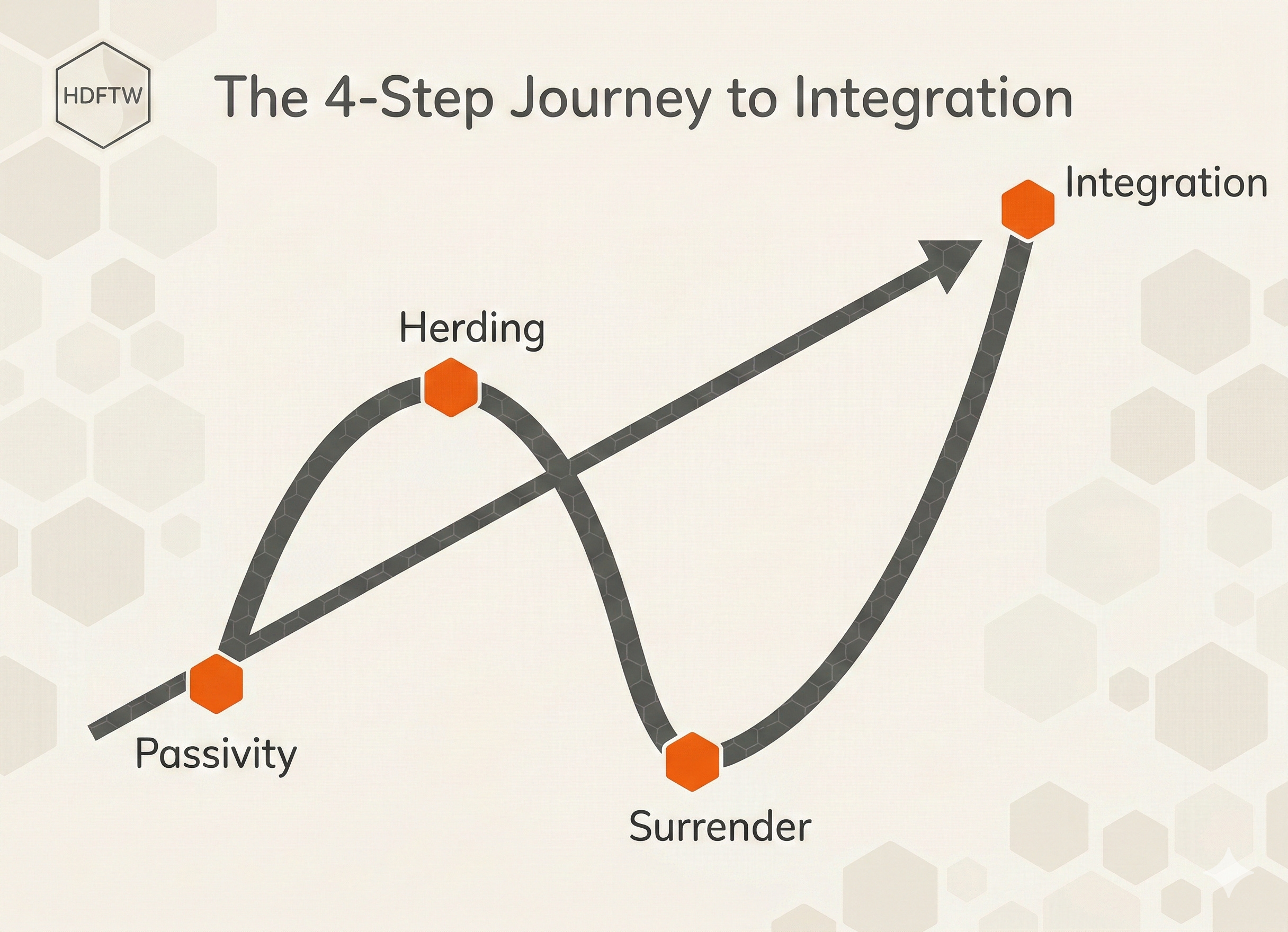
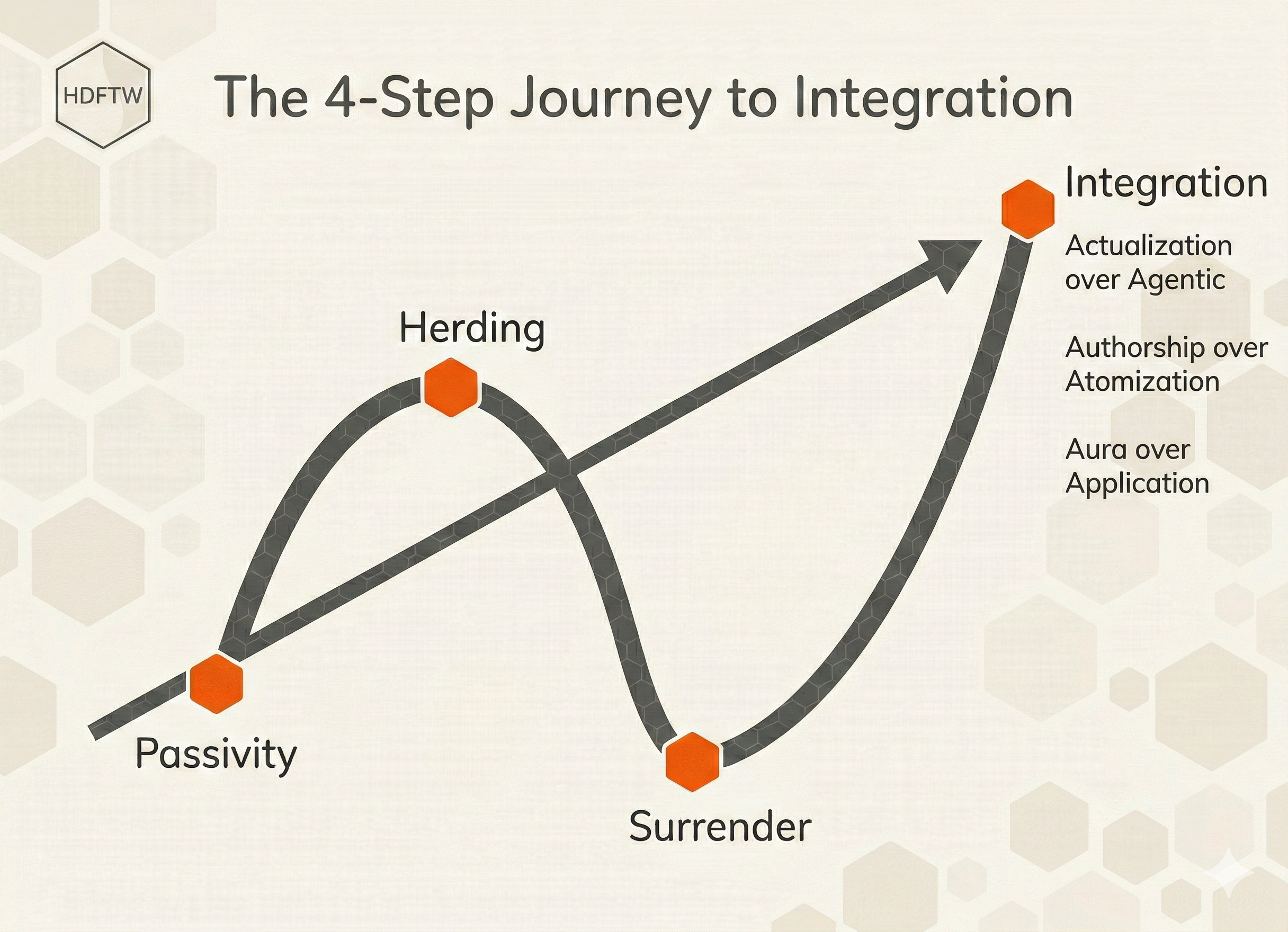
What happens to people in high-uncertainty moments? Historically, and right now in tech, I think it shakes out into four phases:
1. Passivity
Passivity.
That’s the polite word for it. The real word is freezing. You don’t move. You don’t quit. You don’t pivot. You just... keep doing the thing you were doing and hope it still counts.
I get it. I’ve done it. Most of 2023 and a lot of 2024, that was the default posture for people I know in tech. Update the LinkedIn (but don’t post anything too desperate). Maybe enroll in an AI course so you can tell yourself you’re “upskilling.” Keep shipping. Keep your head below the treeline.
And look, it made sense. The conventional wisdom was: this is cyclical. Hiring freezes thaw. The pendulum swings back. Just survive the winter and you’ll be fine.
But this winter keeps going. In fact Winter is Coming.
And I think the reason it keeps going is that it isn’t winter. It’s a new climate.
There was a recent economic report that puts numbers to what a lot of people already feel in their gut. The labour market is splitting.
On one side: tacit knowledge, the gut-instinct, experiential, can’t-write-it-down-in-a-playbook kind. That’s gaining value.
On the other: codified knowledge, the certifiable, textbook, fits-in-a-curriculum kind. That’s getting automated. (Even the word itself has ‘code’ as the root. Get it?)
They’re calling it a “hiring freeze at the bottom” because the entry points, the junior roles, the paths that used to absorb fresh grads and train them up, those are exactly the jobs that AI does now.
Codified knowledge. That’s what most of us spent our first few jobs accumulating. That’s what the resume is. That’s what the credential is.
And here’s the thing with passivity. It doesn’t feel passive from the inside. That’s the trick. (That’s always the trick with the things that get us.)
From the inside it feels like the responsible thing. You’re still showing up at the All-Hands. Still shipping features. Still saying the right words in the 1:1s and your manager still nods at your updates. The paycheque still funnels through to your account.
Everything is confirming that what you’re doing is fine.
But what you’re actually doing, underneath all that professionalism, is making a bet. You’re betting that what you know is still the thing that protects you. That the credentials and the years of accumulated expertise, all of that knowledge you spent a decade building up, that it still means what it used to mean.
Knowing as security. That’s what passivity really is.
In a displacement cycle, what I know should be enough isn’t a strategy. It’s standing still while the ground moves under you. And the ground is moving fast enough now that standing still is falling behind.
And then one day something cracks. Maybe it’s a reorganization. Maybe it’s like the Block announcement from Jack-knows-where. Or maybe it’s nothing that dramatic, maybe it’s just a feeling, this low hum in the back of your head that says knowing isn’t enough anymore.
That hum, once you hear it, doesn’t stop.
And the first thing it makes you do is look around to see what everybody else is doing.
2. Herding
So you stop being passive. You start moving.
The question is: where?
And when nobody knows the answer to that, the instinct is to look at where everyone else is going. Which, right now, is AI. Read the same ten Substacks (hi). See what the next X article that unlock that thing for you. Build an agent. Ship it. Then ship some more.
Herding.
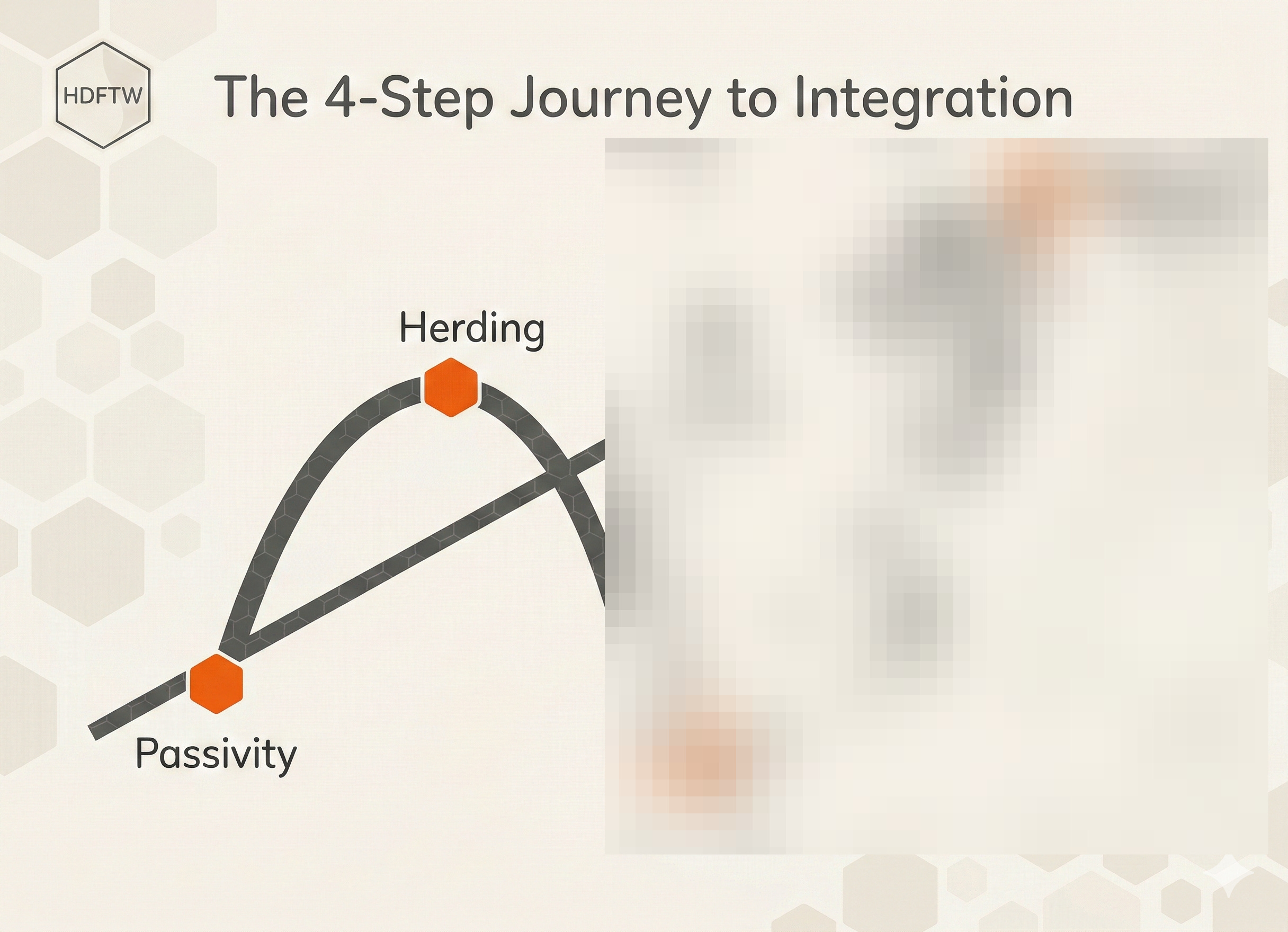
It’s not a dumb response. It’s actually the rational thing to do when the signal-to-noise ratio is fuzzy. You look for patterns in what other people are doing and you follow the biggest and/or fastest.
Granted, that’s how markets work, how migrations work, how safe human decision-making under uncertainty works. (No one got fired for buying or hiring IBM, isn’t the the phrase!?)
The problem is that herding only helps if the herd knows where it’s going.
And right now the herd doesn’t know with certainty. Not fully. Not really. The herd is just moving because moving feels better than sitting still or just out of rear you don’t want to be left behind and be eaten by the lion. That’s what herds do. Move first, think later.
Learning a new playbook feels like progress. Shipping a side project feels like relevance. Quoting Sama or Dario on LinkedIn feels like participating in the conversation. (It isn’t, but it feels like it.)
Here’s why herding hooks smart people more than most. Passivity was knowing-as-security: what I already know will protect me. That is fast fading or has failed.
So herding flips it.
Herding is knowing-as-currency: if I learn the NEW thing fast enough, I’ll be safe again. Different bet, same operating system. You’re still inside the knowing paradigm. You’ve just changed what you’re trying to know.
But the herding instinct runs deeper than strategy. When the structures that used to hold your identity together, the team, the title, the company, the calendar full of meetings that at least told you where to be at 10am, when all that dissolves, the herd becomes a replacement.
The Discord. The cohort. The X feed carefully curated with all the tech pros (and bros) showing you what their latest setup is.
These become your new team. Your new identity container. (I know because I’ve needed that container and I’ve also been the person pretending I didn’t need it while absolutely needing it.)
But yet, it’s still what you do, day-in, day-out. You herd because you don’t know what to do. The herd doesn’t know either. But the herd produces a consensus that looks like knowledge (everyone says “learn AI,” so learn AI must be the answer). You follow the consensus. You learn AI. You’re now one of 200,000 people who learned AI.
Part of the herding is that you’re running away from the loneliness of losing your professional identity is brutal. So herding isn’t just about finding the right skill to learn or the next app to build.
The consensus was correct in the abstract and useless in the specific.
The problem isn’t that you’re not learning fast enough. The problem is that learning faster was the old game and the old game is the thing that’s ending.
That’s The End of Knowing.
Right there.
Knowing-as-security failed. Knowing-as-currency is being quickly eroded away. And when both fails, when the whole apparatus of knowing more to stay safe stops generating answers, the next thing that breaks isn’t a skill or a strategy.
It’s you.
3. Surrender
Where you stop running. Where the hustle, the upskilling, the networking, the “staying relevant” … all of it just ... stops. Just silence.
One of my all time favourite movies was about the Great Financial Crisis (yet another herding event). Margin Call. Have you seen it? My god that is one of my favourite movies that I rewatch every year at least once. Granted I skip to my favourite scenes.
Spoiler Alert here if you haven’t seen it. But the CEO of one of these Lehman-esque companies is facing imminent death. And he just says that he cannot hear the music anymore: “just silence”.
And the silence is deafening but after the moment when you’ve realized what is happening you just have to stop and do something else.
Not because you decided to stop. Because something in you ran out.
Surrender.
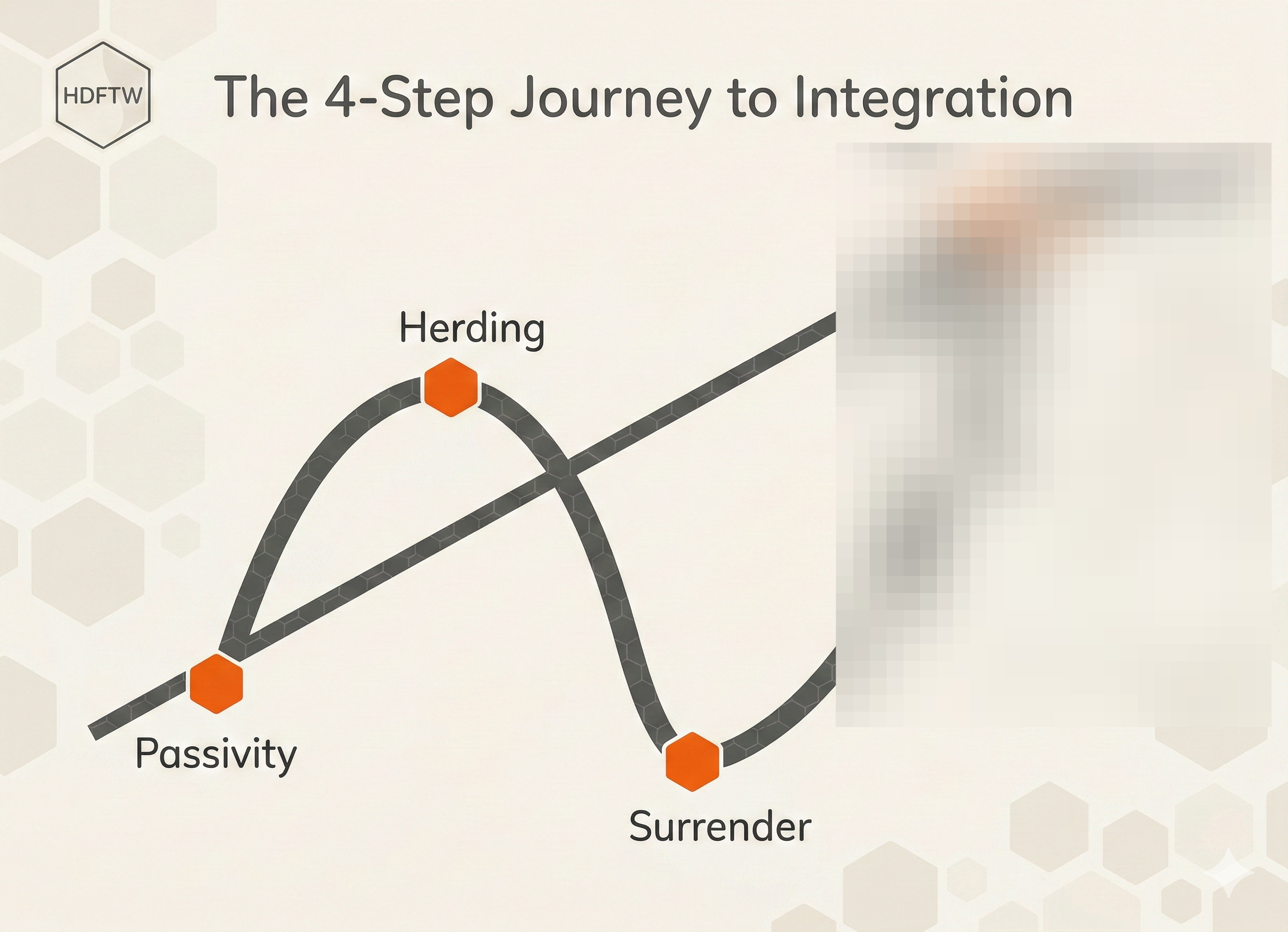
Another word that gets a bad rap. Sounds like giving up. Sounds like defeat. And maybe sometimes it is.
But I think there’s a version update that’s actually closer to the truth.
Passivity and herding broke things at the surface. Your knowledge was/is no longer enough. Your new knowledge wasn’t enough either. Scary, but still manageable. You can strategize around not having the right skills.
Surrender breaks something deeper. Surrender is where knowing-as-identity cracks.
For a lot of us in tech (and I include myself firmly in this bucket), being the person who knows things isn’t just what we do. It’s who we are.
The kid who was good at school became the adult who was good at work became the professional whose value was in their expertise. Knowing things is how you got promoted, how you earned respect, how you knew where you stood in your life.
Whether we like it or not or whether we want to just stop ourselves from asking, we tend to ask these to new strangers we meet: “And … what do you do?”
It’s so deep in the wiring of professional identity that most people don’t even see it as a thing. It’s like asking a fish about water.
And surrender is the moment the water drains out.
It doesn’t happen in a big dramatic way usually. It’s just like any other Tuesday. You open your laptop and look at the side project or the job board or the online course, whatever the thing was that the herd was doing, and you just... can’t.
Not in a tired way. In a why way.
The why itself ran out. The whole framework you used to navigate your career, the know-more-climb-higher operating system, just stopped generating answers. Not wrong answers, just no specific answers.
And our whole tech industry is wired for doing. Ship. Iterate. Move fast. Take action. (I didn’t say break things, did I?)
Surrender is the place where the doing stops and you’re left with just... you. Without the title. Without the expertise. Without the knowing. Just you, which turns out to be a person you might not have actually met in a while.
It’s not just one thing that goes either. Your security (the paycheck, the stability). Your belonging (the team, the daily rhythm, the being-part-of-something). And your identity (being the person who knows things, the expert, the title).
When all three go at once, it’s not a career setback. It’s closer to losing a version of yourself.
Maybe a lot of people in tech are here right now. Still employed, some of them. Still performing. Still hitting their OKRs. But somewhere underneath the performance, something cracked and they haven’t caught up to the crack yet.
(Which is, when you think about it, the most tech thing ever. We build systems that outrun us because that’s what tech should be in the first place, but then we’re surprised when the same thing happens to our own careers.)
I don’t think one can skip surrender. Having gone through it, it’s something you have to go through. Because you can’t build something new on top of something you’re still white-knuckling.
The old model has to actually loosen its grip on you before you can see what’s underneath it.
And what’s underneath it is the interesting part.
4. Integration
That silence from the movie again. That’s what the space between surrender and whatever comes next actually sounds like. Nothing. No new plan. No revelation. No “aha” moment where the clouds part. Just weeks, maybe months, of being a person without a script.
And the terrifying part, honestly, is that it doesn’t feel like progress. It feels like nothing is happening. You’re not learning. You’re not building. You’re not moving. And everything in your training, everything tech taught you about shipping and iterating and moving fast, is screaming that you’re wasting time.
You’re not. But you won’t believe that until later.
So.
Passivity didn’t work because the ground moved. Herding didn’t work because everyone ran to the same place. Surrender by itself just leaves you sitting there, which is honest but not a strategy.
What’s left?
I think it’s something like putting yourself back together. But differently.
Not going back to the old model (it’s fundamentally changed and likely gone forever). Not finding the next model to follow (that’s herding again). Something more like figuring out what was actually yours all along, underneath the job titles and the frameworks and the credentials, and building from that.
Integration. The re-assembly. You can call it re-factoring if you want. Or just erasing the tech debt that you never needed in the first place.
Now here’s where I want to be precise. Because it’s easy to hear “figure out who you really are” and think that’s one more thing to learn. One more course. One more personality test.
(God knows we’ve all done enough of those. I’ve got a drawer full of Myers-Briggs results and StrengthsFinder reports that told me useful things for about six weeks and then gathered dust.)
Integration isn’t knowing who you are. It’s remembering.
Remember this is The End of Knowing.
Remembering. That’s the word I keep coming back to and it took me a while to get to it.
Knowing and remembering sound similar but they’re opposite movements. Knowing goes out. You acquire, you accumulate, you add. That’s the whole career ladder. More knowledge, more credentials, more rungs.
Remembering goes in. You peel back. You uncover. You find the thing that was already there before you started piling stuff on top of it.
Think about the moments in your career where the work didn’t feel like work. Where the challenge in front of you and whatever it is you actually are just... fit. Where time did that weird thing where three hours go by and it felt like twenty minutes. Where the energy came back to you instead of draining out.
One of the most well-known researchers in the field of human performance spent decades studying exactly that. He called it Flow. And his big finding was that flow happens when the challenge matches the capability, when there’s clear feedback, when you’re fully absorbed.
But the part that matters here, and I think it’s the most interesting thing in his whole body of work honestly, is that the capability that produces flow isn’t usually the one on your resume. It’s something underneath. More wired. More consistent.
The resume skill got you in the door. But the wired thing, the thing that was there before the resume, that’s what produced the flow.
And most people in tech have had these moments and never stopped to ask the obvious question: why those moments and not the other 90%?
That question. That’s where integration starts. Not with a new framework but with an honest look at what was already happening when things clicked.
The End of Knowing, it turns out, isn’t the end of everything. It’s the end of one particular operating system, the know-more-climb-higher one. And underneath it, there’s something older. Something that was running the whole time.
The wiring. The consistent stuff. The thing about you that doesn’t need a course or a credential because it predates all of that.
Integration is the act of turning toward it instead of away from it. Of remembering instead of accumulating.
And here’s what I think makes that empowering, even if none of this feels particularly optimistic. It’s not that the journey ahead is easy. It’s that you now have a map. Maybe you’re in passivity right now, relying on your credentials. Maybe you’re herding, running with everyone else toward an agentic tomorrow because at least it’s movement. Maybe you’re in surrender and the silence is deafening and you don’t know who you are without the title.
Wherever you are on this thing, knowing the terrain changes your relationship to it. Passivity isn’t failure. It’s a stage. Herding isn’t weakness. It’s a stage. Surrender isn’t the end. It’s the clearing. And Integration isn’t some far-off enlightenment. It’s what happens when you stop piling things on and start looking at what was already there.
“Addition by subtraction” was how a fellow Founder friend used to call it.
The map doesn’t make it hurt less. But it means you’re not lost. And in a world where everything is telling you that you should be lost, that might be enough to keep moving.
But I’m getting ahead of myself. (I always do.) Before we talk about what integration looks like in practice, I gotta point out something important first.
The Role of Luck (or Being At the Right Place and the Right Time)
The reality is that we have to acknowledge the role of luck.
Warren Buffett would say that he was very very lucky: he won the Ovarian lottery5. What he was grateful for was being born in America and during a time when things were booming and in a mostly peace-time mid-western town.
Life is no different now, we all need luck or serendipity or just being at the right place at the right time, divine providence — however you want to call it and embody it.
And I bring this up here because it would be dishonest not to. Everything I just laid out, the four stages, the journey from freezing to re-assembly, all of that is real and I believe in it.
But it doesn’t happen in a vacuum. It happens inside a life. And that life has a context.
Do you have savings? Do you have somebody at home who can carry the rent for a few months while you figure things out? Do you have a passport that lets you work in the places where the jobs are? Were you born into a family that could absorb the shock of you not having a plan for a while? Lawrence Yeo calls it patronage. It’s a tailwind, so use it for as long as you can.
(I was lucky in some of those ways. Not all of them. But enough of them that I’d be lying if I didn’t say so.)
Buffett wasn’t being falsely humble about the ovarian lottery. He was being surgical. The single biggest variable in his story wasn’t intelligence or temperament or strategy. It was context. Where and when and to whom he was born.
And remembrance, the thing I’m pointing at in Integration, that requires space too.
Space to sit still. Space to not produce for a while. Space to let the old identity loosen its grip without the terror of an empty bank account making you grab for the first rung of whatever ladder is closest.
Now. With all of that said, and with the map laid out, and with luck acknowledged for the massive variable that it is, there are three things I keep coming back to. Three ways integration starts to look like something you can actually do. Not a checklist. More like three shifts in orientation that I’ve seen matter, in my own life and in what I keep noticing around me.
Actualization Over Agentic
“If you have a 150 IQ, sell 30 points to someone else. You need to be smart, but not a genius.” — Warren Buffett
I invoke Buffett again briefly and it’s important when we want to Integrate The End of Knowing. He’s talking about having an adequate enough IQ in investing and that temperament is actually the even more critical thing.
But I posit that this is apt for what’s happening in our industry. It isn’t the knowledge that is the primary lever now. (Remember Atlas.)
Everyone in the Valley keeps saying agency. Have agency. Take agency. Build with agency. And sure, agency sounds like the answer. But here’s the catch: agency is just agentic with a human face. Both are about executing. Both are about doing the thing faster, smarter, more autonomously. And if the machines are about to be better at autonomous execution than any of us (and they already are), then agency as the Valley defines it has an arbitrage expiration date too.
So I want a different word.
Actualization.
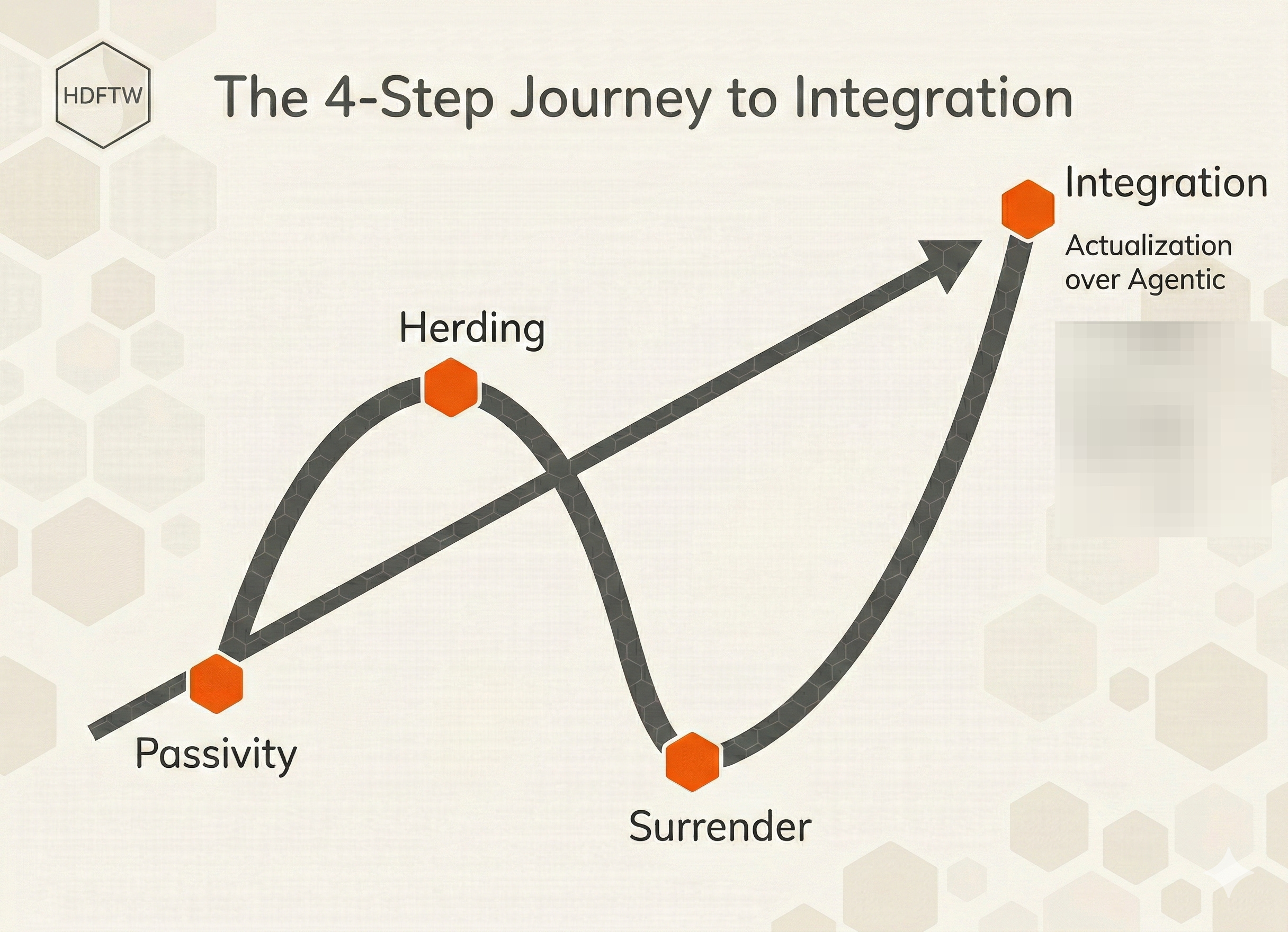
To actualize something is to make it actual. To make the latent thing real. To take what was always there in the design and bring it into operation.
That’s different from agency. Agency says: go do something. Actualization says: become the thing you already are, and let the doing flow from that.
The time before this was an unbundling of skills into ever increasing specializations. That’s what the first and second industrial revolutions pushed for, whether we wanted it or not.
It got us into a lot of trouble, we brought it down so much that we forgot how to put Humpty Dumpty together again in the very same hand, we broke our bodies, our minds in thinking work is just … reductionist.
Knowledge work that grew in prominence as a percentage of GDP in the 1970s and beyond as it replaced agriculture and manufacturing work particularly in the “West” meant that we had new prisons we boxed ourselves in. In our suburban homes, in our fluorescent light cubicles.
The tech industry tried to put lipstick on a pig (and still does) by making us feel better about it: free lunches, standing desks, team bonding events that cost a lot of overhead.
Not saying that I didn’t enjoy or partake in those things, but it’s good to call them out for what it is: a carrot.
It might sound harsh, but what I’m trying to paint is not the individual experience so much, but a fundamental reality of our market economies in the labour markets in particular: the scarcity was the white matter between our ears and that was what made knowledge work so well paid (for a time).
Added to this was the increasing specialization gently pushed by the invisible hand, pushing that to the extremes, and the knowledge itself spawned sub-domains of knowledge that needed ever increasing amounts of time to learn, retain and build upon.
That has all been upended by AI. You don’t need me to tell you this.
Upended is a good word.
The up is the bottom.
The bottom is up in this inverted pyramid.
But we all knew this was gonna happen.
We knew it was the end result of the scaling laws all the way back from the ChatGPT moment onwards.
Knowing it is one thing. Doing something about it, well… that’s where actualization starts.
It’s not just knowing it. But embodying it.
Not more content consumption, not more of this or that article (including the very one you’re reading now. Though don’t stop here.)
Life — and your life’s work — is a virtuous cycle of recognition not recitation.
You start actualizing the moment you stop asking what should I do? and start asking what am I built to do? The difference sounds subtle. It isn’t. One question sends you outward, to the herd, to the market, to the job board. The other sends you inward, to the wiring, to the consistent stuff, to the thing that was running underneath the career the whole time.
Forget about using Claude Code. Or Codex. Or Obsidian. Or Computer.
Everything is Computer6, right!? ;)
Don’t let IT use you.
Use it while not being used by it.
In the world where there is the end of knowing.
And once you start asking the inward question, the next thing you notice is that you can’t answer it alone. Which brings us to the people around you.
Authorship Over Atomization
If actualization is about you, authorship is about what happens when you put a few of you together.
But first. Think about what happened to us.
The industrial revolutions split work into specializations. Knowledge work split those specializations further. And then tech split them again. And again. And again.
You weren’t an engineer. You were a frontend engineer. Then a React specialist. Then a Senior React specialist focusing on design systems at a Series B fintech.
Each decade, the slice got thinner. Each rung on the ladder, narrower.
Atomization.
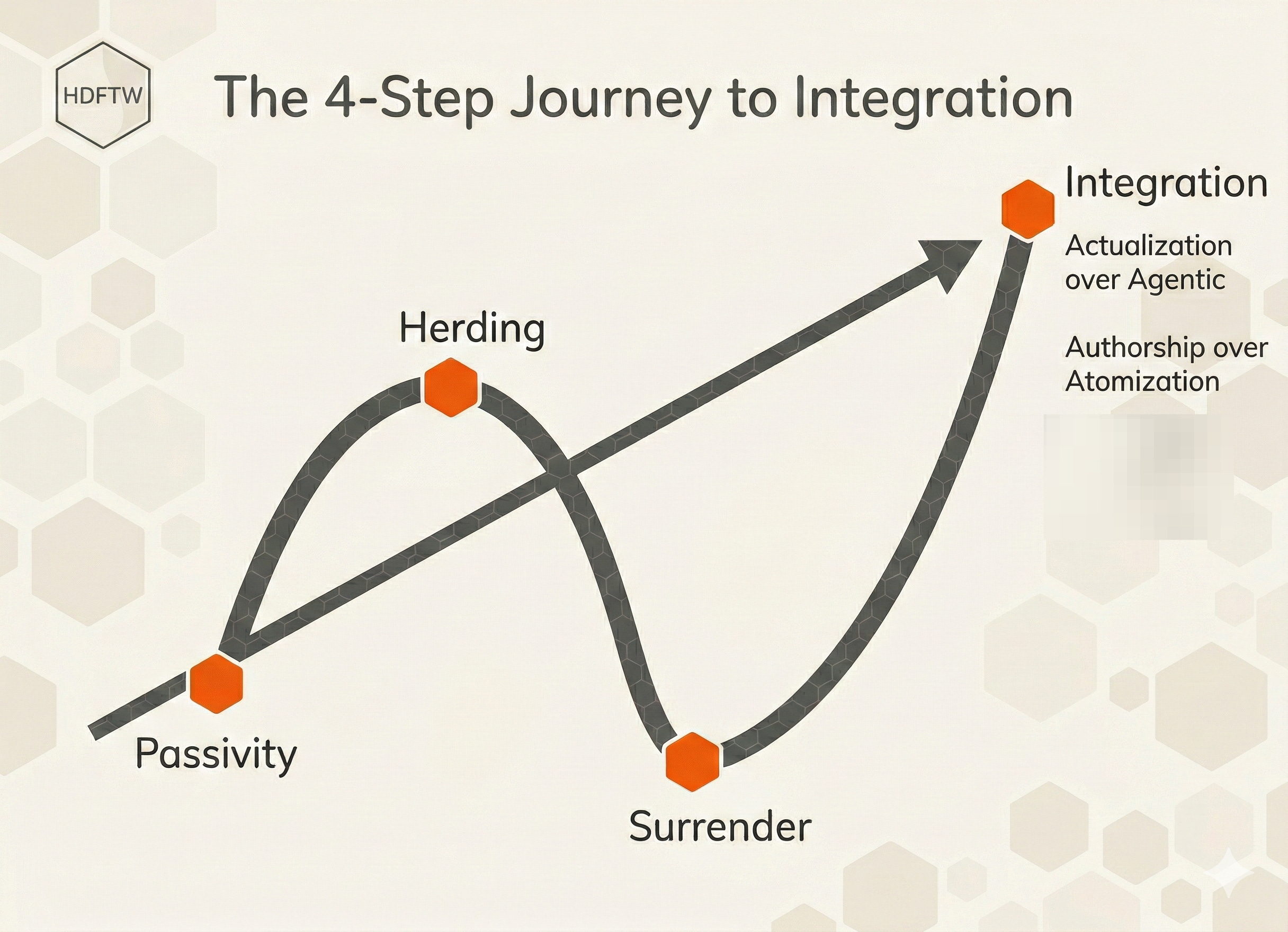
That’s the word for it. The system took whole people and broke them into atoms. Narrow, specialized, interchangeable atoms. And the thing is, it worked. Because the institution was the molecule. The corporation held all the atoms together. You didn’t need to be whole. You just needed to be your atom and the org would provide the rest.
The structure. The belonging. The identity. The plan.
(That was the deal. For decades, that was the deal.)
And the deal is breaking.
The layoffs aren’t just cutting headcount. They’re dissolving the molecule. And an atom by itself (a hyper-specialized slice of a person floating free with no structure to give it meaning) that’s what a layoff actually feels like, isn’t it?
You weren’t just removed from a job. You were removed from the thing that made your specialization make sense.
So what replaces the molecule?
Shopify’s founder and CEO:
“We think the best team size is one, because a single author can do things that is impossible to do for teams, and hit high notes that are unreachable.”
And he goes on:
“Most projects worth doing need to be done in teams. There’s a magic number at five. It’s sort of what military ends up figuring out too. They test these things and come to the same conclusions.”
Author. That’s the word he uses. Not specialist. Not resource. Not headcount. Author.
Sit with that for a second.
An atom is interchangeable. You pull one out, you slot another in. The molecule doesn’t care which atom, as long as the slot is filled.
An author is the opposite. An author is the whole person showing up with something that comes from their complete wiring. Not the slice the org chart assigned. Not the narrow specialization. The whole thing. The thing that was there before the title existed.
And this is where the wiring I talked about in Integration becomes visible.
In a group of five, you find out pretty quick who actually does what. Not what their title says. What they do.
Who sees the problem before anyone else. Who holds the group steady when things go sideways. Who’s already three steps ahead building something while the rest of the room is still talking.
Who translates between the person with the vision and the person doing the implementation, because those two are never speaking the same language and somebody has to bridge it.
In a hundred-person org, nobody notices if the wiring doesn’t match the role. The molecule absorbs it. Somebody compensates. The mismatch hides.
(That’s atomization working as designed. The individual doesn’t matter as long as the atom is in its slot.)
In a team of five it can’t hide. You feel it in about a week.
And when the wiring matches with each person is carrying the function they’re naturally built for — the whole thing hums.
That’s what Humpty Dumpty looks like when you actually put him back together. Not the old way, with the org holding the pieces. The new way, where each piece knows what it is.
Think about the best team you were ever on. Not the one with the best resumes or the biggest budget. The one where it worked. Where each person carried something the others couldn’t, and you all knew it without having to say it.
What was the thing you carried? Not your title. Not your deliverables. The thing underneath that.
The function only you filled.
That’s the authorship question. And if actualization is the inward turn, authorship is where that turn meets other people. Which leaves one more piece, and it’s the one that ties it all together.
Aura Over Application
And then there’s the piece that might sound the weirdest. But stay with me.
Someone posted something on X the same day the Block news dropped that I keep going back to:
“Big teams = out. Small teams = in. I’ll share a secret that I could easily charge 7 figures for, it is now more important than ever to understand how to increase your aura. Small teams are not built through the traditional hiring process you’re used to. It’s all about aura.“
“Aura.”
I know. I know how it sounds.
He doesn’t define it cleanly. He kind of treats it like premium knowledge (which, okay fine, his prerogative).
But you read enough of his stuff and you start to see what he’s getting at.
Aura. Let me sit with that word for a second.
It isn’t hustle. It isn’t personal branding. It isn’t your LinkedIn headline or your portfolio site or the side project you shipped last weekend.
It’s something quieter than that. More consistent. The thing about who you are that other people can feel before you’ve said anything, that makes them want to work with you, build with you, be in the room with you.
Something you can’t perform. Something that shows up whether you’re trying or not.
When somebody posted the headcount across big tech (Meta 87k, Microsoft 221k, Google 190k, X at like 30), his whole response was one word:
“Aura.”
And here’s where it gets interesting for me. He says you can learn to harness it. Lean into it. That it’s buildable.
I think he’s right about that.
And I think I can go further than he does. Because aura isn’t just a vibe. It’s specific. It’s made up of things. The way you process information. The way you make decisions. The energy you bring into a room and the energy you absorb from it. The consistent patterns that show up every time, in every role, at every company, whether you’re aware of them or not. There are mechanics underneath the mystique, and they’re mappable.
Why do some teams click and others don’t, even when the resumes are equally impressive? Why does one person’s presence make a room sharper and another’s makes it muddier? It’s not random. It’s not just “chemistry.” There’s a structure to it, and it has to do with what each person is actually wired to contribute versus what the role sheet says they’re supposed to contribute.
Application is the old game. Apply for the job. Apply the framework. Apply the skills you learned. Fill the slot.
Aura is something else. It’s what’s left when you strip the applications away. The part of you that doesn’t change when the job changes, when the industry changes, when the tools change.
The wiring.
And I think in a world where the applications are being automated faster than anyone can learn them, the aura, the consistent wired-in stuff, may very well serve as the only anchor and tether to you being you.
So where does that leave us?
Four responses to not knowing. Four different relationships to the thing that’s ending.
Passivity treats knowing as security. Hold still, trust the credentials, hope it passes. The ground moved.
Herding treats knowing as currency. Learn the new thing, faster, before everyone else. But when everyone learns the same thing, the currency inflates to nothing.
Surrender is where knowing-as-identity breaks. The expertise, the title, the “being the person who knows things,” all of it cracks. And what’s underneath is a person you might not have met in a while.
Integration is remembrance. Not learning who you are. Remembering. The wiring that was always there underneath the career. And building from that, through:
actualization (not just execution)
through authorship (not just roles)
radiating aura (not just applications)
But here’s what I want to leave you with. The thing I keep coming back to.
The four stages aren’t a diagnosis. They’re a landscape. And the fact that you can see the landscape, that you can look at where you are and call it by name, that changes everything. Not the circumstances. The circumstances are still what they are. But your orientation to them.
Passivity has power in it once you see it for what it is. It means the old model mattered to you, that you built something real on it, and you’re grieving its end. That’s not weakness. That’s experience.
Herding has something real in it too. The impulse to move, to seek, to not sit still, that’s energy. The problem was never the energy. It was the direction. Herding pointed it outward, toward the crowd. Integration points it inward, toward the wiring.
And surrender, the part that feels the worst, the silence, the identity crack, is actually the clearing. It’s the moment the old operating system finally stops running and you can hear what’s underneath it for the first time. Most people will tell you that’s a breakdown. I think it’s closer to a reboot.
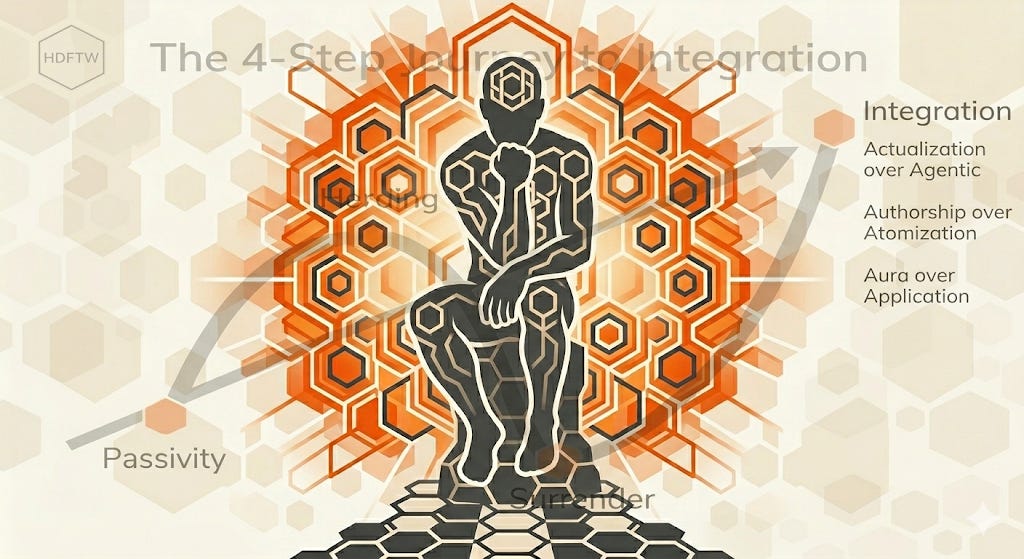
The End of Knowing isn’t the end of you. It’s the end of one operating system. And underneath it, something has been running the whole time. Quieter. More consistent. Yours.
The question isn’t whether you’ll find it. It’s whether you’ll stop long enough to remember that it was always there.
If you were affected by what happening the tech industry, reach out. I’m doing free career consults for anyone in transition. No pitch, just conversation if you feel like taking the next step.
https://www.britannica.com/animal/dodo-extinct-bird
https://www.christenseninstitute.org/theory/disruptive-innovation/
https://shop.sonymusic.ca/products/our-lady-peace-spiritual-machines-vinyl
https://buffett.cnbc.com/video/1997/05/05/buffett-a-lot-of-people-dont-win-the-ovarian-lottery.html
https://www.yahoo.com/lifestyle/donald-trump-saying-everythings-computer-163816498.html