

“Org compression/the end of companies: Coordination costs drop and small teams can do big things, dropping minimum company sizes. We might even see a return of temporary, purpose built companies (like film productions or joint-stock companies).” — 99% Derisible
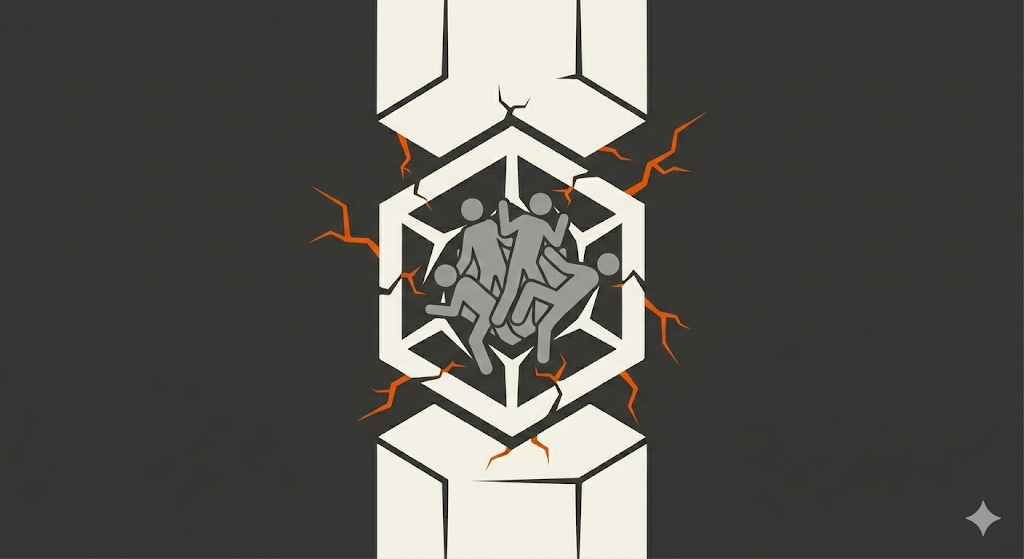
I read that and went straight back to my last PM gig at a unicorn where my week was maybe 4 hours of product thinking and 30 hours of duct tape. Chasing Jira updates, running stand-ups that were really just roll calls, translating between engineering and design who somehow never agreed on anything (every sprint, without fail), writing the recap nobody read but everyone asked for when I skipped it.
30 hours of glue. 4 hours of the job I was hired for. I think that ratio is way more common than anyone admits and I think the glue part is where AI shows up first.
What Are We Actually Asking
Everyone’s debating whether AI can code or write PRDs or design interfaces and those are interesting questions but I think they’re beside the point.
Where inside your team is the pressure building? Where are roles getting squeezed? The people running these companies are telling you.
Tobi Lütke, Shopify CEO, to his entire company:
“Before asking for more headcount and resources, teams must demonstrate why they cannot get what they want done using AI.”
And on team size:
“Shopify loves the five-person team... we think the best team size is one, because a single author can do things that is impossible to do for teams.”
Best team size is one. CEO of a 10,000 person company, on the record. All those meetings where six people watch one person talk while the rest of the room is on Slack under the table, the syncing and handoffs and status updates, the software is starting to handle that. My 30 hours of duct tape? That’s the part getting automated.
Team Formation
In BG5 Consulting, there is a model for what happens when 3 to 5 people come together to build something and it has nothing to do with your org chart.
Every team has two halves. The Head handles direction, roadmaps, retros, demos, memory. The Engine handles action, capacity, cadence, shipping, getting the thing out the door.
When both work you get that feeling where the output is bigger than the sum of the room. I’ve had that maybe twice in fifteen years.
When they break it goes one of two ways. Beautiful strategy nobody ships (leadership presents the roadmap and the engineers are looking at each other like... with what army?) or incredible velocity in every direction at once with nobody able to explain why (and the PM writing the narrative retroactively to make it look intentional, which guilty).
The Big Squeeze
The coordination between those two halves, the stuff that keeps Direction and Action talking to each other, that’s where the tools are stepping in.
A Scrum Master used to facilitate consensus in the room, asking what should we do, guiding the conversation, which was democratic and also sometimes painfully slow.
The tooling now just reads commits and activity and reports what shipped.
A PM used to chase Jira updates to keep sprints honest, now the system of record does that in real time. If it’s not logged it didn’t happen.
The standup that interrupted everyone’s morning at 9:15 for a twelve minute roll call? Automated nudges handle that now.
Capacity planning that used to be part negotiation part vibes? Increasingly just math.
Before and After
2023. Eight people proving they’re working in a synchronous meeting. The work about the work exceeds the work (try saying that five times fast).
2027+. Tools read the work, flag blockers, set the pace. Maybe you still meet but it’s about something for once (revolutionary concept). People go back to doing the part the tools can’t touch, the creative call, the weird insight, the judgment that makes no sense in a spreadsheet but ends up being right.
The Part That Doesn’t Compress
Here’s where I land on this though and this is where the BG5 work started clicking for me.
Job titles and fictional team boundaries aside, everyone on a team can fill in for each other to some degree. We all can and do wear multiple hats.
But there was always someone doing a thing that wasn’t on any job description.
On one of my teams there was someone who was just the kindest person in the room. She lit it up when she walked in, even on virtual calls you could feel the energy shift. She wasn’t the team lead or anything close to it but she set the emotional tone for the rest of us and honestly that’s how influence actually works on a team, not through title but through presence.
And then there was a guy who was probably the most reliable person I’ve ever worked with. Before I even finished explaining what needed to happen he’d already be asking questions about how to implement it, not because he was trying to get ahead of me but because he was genuinely curious and interested in the problem. That kind of energy on a team is hard to describe on a resume but you feel it immediately when it’s gone.
In BG5 these are called functional strengths. The role you play when the job description falls away and people are just working together on something real. And I think once the duct tape work gets cleared away by the tooling those strengths become way more visible. There’s less noise around them.
Which was kind of a relief for me when I first encountered this framework. Because it means the path forward isn’t learning yet another tool or cramming another certification (we’ve all done plenty of that). It’s getting clearer on what you already bring.
I’d pay attention this week actually. On your team, where does influence happen versus where the org chart says it should? Who sets the tone? Who’s already solving the problem before the ticket gets written?
That might be the more interesting question right now, especially when something big is happening1.
I’m Eugene, a former tech builder (Engineer, Designer, PM, Founder) who learned the hard way that burnout is a bug, not a feature. Whether you need to Level Up, Enter, or Exit the industry, I help you debug your career and decode your unique Career and Business Success Code to navigate AI displacement without the system crash.
If you want to see what BG5 says about your specific functional strengths, the Career Success Code Report is a good starting point. It maps the role you tend to play in a small group and it’s kind of wild how specific it gets. Download yours and see if something clicks.
And if you want to talk through what any of this means for your career right now, I do free consults. Reach out below.
