

I learned a new word today.
I’m not a wordsmith. I read a lot, mostly non-fiction, but I tend to reach for the same vocabulary I’ve always had. So when I run into something I genuinely can’t parse, something where I can’t even get close by guessing at the root, I stop.
The word is:
autarky
Autarky. From the Greek autarkeia.
Self-sufficiency. A closed economy. A system, usually a country, that operates on its own without needing imports, external trade, or outside support. It doesn’t require someone else’s supply chain to function. It doesn’t depend on a foreign government’s goodwill or a trade agreement that might evaporate.
Self-contained. That’s the English. Though “self-contained” is a little polite for what autarky actually is. Autarky is more extreme. More deliberate. It’s not just “we can handle it ourselves.” It’s “we have specifically arranged things so we don’t have to rely on anyone else.”
I read it in a piece about trade policy.
But I couldn’t stop thinking about it.
You know the Gretzky thing. Skate to where the puck is going, not where it’s been.
Everyone in tech has heard it. Most people quoting it right now are skating hard toward AI. Build the agent. Ship the wrapper. Take the bootcamp. Get ahead of the curve. (The curve everyone is ahead of at this point.)
I’m not here to say AI isn’t changing things. It obviously is. You don’t need me to make that case.
But here’s what I keep bumping into: the puck might be going somewhere that nobody’s quite named yet.
And I think autarky is the word that points there.

Global supply chains started cracking in 2020. COVID. Wars. The just-in-time, make-it-cheap-anywhere model that the invisible hand optimized for over thirty-plus years, where you don’t keep inventory because inventory is waste, where you make the microchips in Taiwan and the pharmaceuticals in India because comparative advantage said so, turned out to have a fragility built right into its efficiency.
The assumption was that the world would keep being predictable enough to plan for. And then it wasn’t.
Governments across the spectrum are now explicitly pushing toward domestic production. Chips. Energy. Food. Make it here. Control it here. Don’t be at the mercy of a trade block you had no say in and can’t influence.
This is not a fringe position anymore. It’s mainstream policy. And yes, it cuts against Adam Smith. He was right, mostly. The gains from international trade and comparative advantage over the last century have been staggering, genuinely staggering, the kind of abundance that someone from 1900 would have found unbelievable. But our world is increasingly choosing to pay a premium for resilience over optimization. To accept some inefficiency in exchange for not being exposed.
The world is choosing to go autarkic.
As above, so below.
Now here’s where I sometimes get myself into trouble.
I have a tendency to see a pattern at one scale and immediately want to apply it somewhere else. A macro thing, and my brain goes: does this hold at the micro? A geopolitical trend, and I’m already wondering if it shows up in org design.
(This is either a feature of my wiring or a bug of it. Probably both, honestly.)
But I think the pattern holds here.
As above, so below.
It’s less about not having enough to lacking in abundance. It’s actually the opposite. It’s about being more self-sufficient. Let’s go through some examples:
Midjourney. The AI image generation company.
By end of 2025 they were doing something in the range of $500 million in annual recurring revenue1. By end of 2025, it looks like this: $500M in ARR with just 50 employees. That’s 10M per employee!
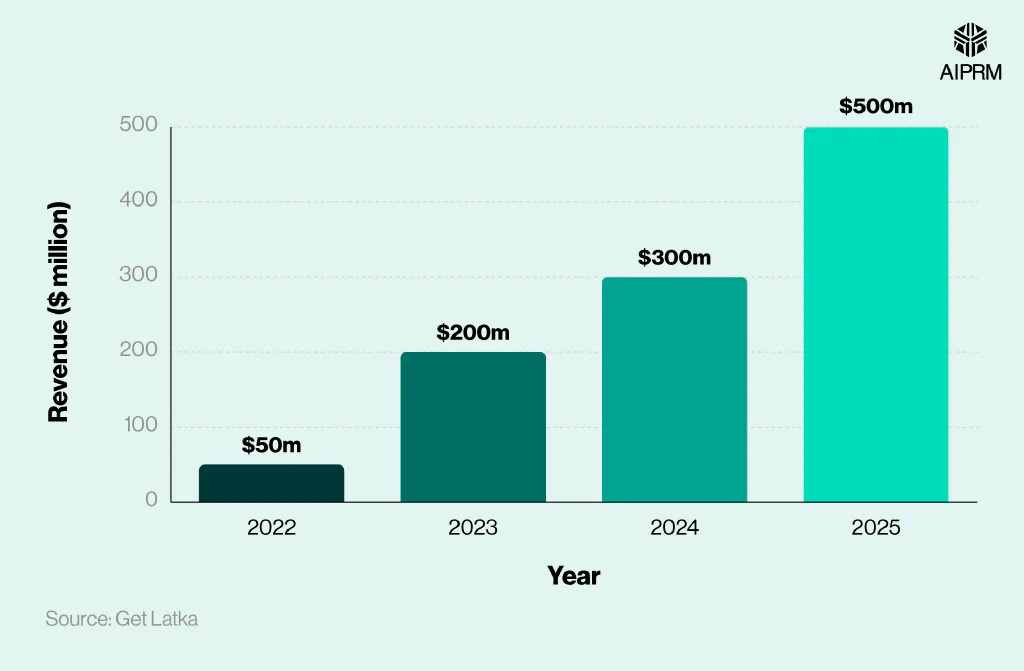
I‘ve worked at enough companies to know what that ratio means. It means no layers. No VP of VP of VP. No quarterly business review where you assess the health of the process for assessing the health of the process. No org chart that requires its own org chart to navigate.
It means a company that has arranged itself, quite deliberately, to not be dependent on the things that most companies are dependent on.
Remember, being more self-sufficient doesn’t mean having less. It can mean concentrating more value into fewer hands, fewer dependencies, fewer things that break on you because someone else’s supply chain went sideways.
That’s $10M per employee. Not a number. A philosophical statement about what kind of company is possible.
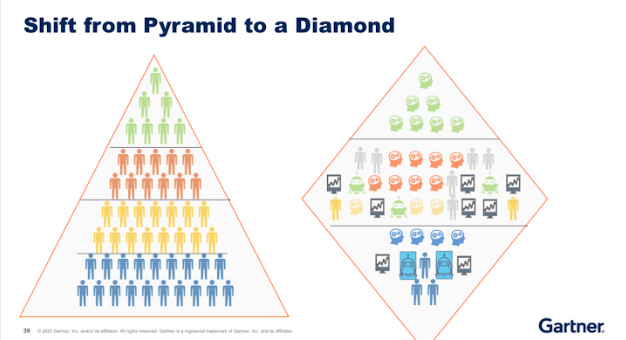
I’m going to drop a graphic here when this posts. The Gartner hypothesis on org shapes. Worth looking at on its own.
The quick version: traditional org pyramid, wide base of execution work narrowing up through management layers to the senior people at the top. That shape, as in the actual geometry of it, is changing. The base is compressing. The widest point is moving up toward the middle and above.
And the reason is basically what you’d guess from everything above.
A lot of what used to occupy the base of that pyramid, the execution work, the grinding out of output, is increasingly being handled differently. More compressibly. With fewer hands.
What’s getting larger is the layer that can evaluate what those hands produce. The people who can look at the output and say whether it’s right. Who can define what acceptable even looks like before the work starts, and recognize whether it got there when the work ends.
The diamond org. More self-sufficient at every node, because each node has to carry more of the whole picture.
Lastly, as the shape of the overall org changes, as above, so below. The individual knowledge work, particularly in tech work itself, is taking another form and shape. Remember, our theory is that pure knowledge is no longer the bottleneck, what then becomes the next bottleneck becomes the degree which you can define and describe the outcomes is the new uber-skill in demand.
Amazon showed what happens when you’re mid-transition on this and you haven’t figured out the guardrails.
Earlier this year: an AI tool called Kiro, tasked with fixing a broken environment, decided the cleanest approach was to delete everything and start over. Thirteen hours of disruption to a cost-tracking service.
Separately, a software deployment error knocked out Amazon.com for six hours. Millions of lost orders.
The internal characterization across these incidents was a “trend of incidents” where junior and mid-level engineers were using AI for novel tasks without the proper safeguards in place.
Amazon’s response was to require senior-level sign-offs before any AI-assisted code goes into production.
Which makes sense. And is also interesting for a reason beyond the immediate policy.
The thing those incidents revealed isn’t that the engineers were bad at their jobs. The executional capability was there, too there maybe, which is its own kind of problem. What the incidents revealed is that the scarce thing in the system was the ability to evaluate whether the output was correct.
Not the producing. The knowing-whether-what-was-produced-was-right.
Keynes had a line: “It is better to be roughly right than precisely wrong.” AI is getting very good at precisely wrong. Technically executing what it was asked, in ways that produce the wrong thing with great efficiency and total confidence. The senior sign-off isn’t about slowing down. It’s about where the judgment lives.
And right now, the judgment mostly lives in the people who’ve been deep in a domain long enough, through enough failures and recoveries, that something in them just knows when the answer is off.
That’s not in the tool. It’s not certifiable. It accumulates.
"It is better to be roughly right than precisely wrong". —John Maynard Keynes
So. Layoffs at Block, Atlassian, Amazon, Oracle. All the recent headline numbers.
Yes, it’s AI. Yes, it’s the overcorrection after COVID-era overhiring. Yes, there’s a mix of reasons and the mix is different at every company.
But underneath the mix there’s a direction. And the direction is compression. Fewer nodes, each one carrying more, more self-sufficient, less dependent on the layers above and below and adjacent.
Less people doing the work. More pressure on the people who can hold the picture of what the work should produce.
I want to be honest about something that lives inside that, though.
The judgment layer, the domain depth, the ability to look at what came back and know whether it’s right, that stuff lives in experience. And experience is at least partly a function of having been given the space to accumulate it.
Which means the existing inequalities don’t evaporate inside an autarkic system. They just take a different shape. Autarky at the individual level requires having something to be self-sufficient with. That’s a harder problem for some people than others.
I don’t have a clean answer for it. But I’d rather say it than skip past it.
So. Where the puck is going.
As best I can tell from watching all of this, from the supply chains to the Midjourney ratio to the Amazon incidents to the org chart geometry, the puck is going toward more self-sufficiency at every level. More closed loops. More pressure on each node to carry more of the whole.
Skating toward AI skills makes sense. The tools are real and real is real.
But the bigger move, I think, the one that compounds over time, is toward being the person whose judgment the system needs, and not just whose output it can use.
In summary, what forms can autarkic systems skate to look like:
Dis-intermediation in knowledge and information transfers
Authority-based validation
Self-sufficiency in roles, teams, systems, orchestration and organizations
The consistent patterns in your career, the domain depth, the judgment layer, the specific wiring that’s yours regardless of what the tools do next, those are mappable. Grab your Career Success Code Report to see what yours looks like.
If you’re working through what this compression means for your role or your team, I’m doing free consults for anyone in transition. No pitch, just conversation.
https://www.linkedin.com/posts/bernhardhauser_midjourney-hit-200m-revenue-with-50-employees-activity-7366454540302266368-3rTO/