

Building on PART 1 that focused on Steve Jobs’ work Strengths of Concentration, Organization and Imagination.
![The Personal Moat of STEVE JOBS [Part 1 of 5]](https://substackcdn.com/image/fetch/$s_!Fsuc!,w_140,h_140,c_fill,f_webp,q_auto:good,fl_progressive:steep,g_auto/https%3A%2F%2Fsubstack-post-media.s3.amazonaws.com%2Fpublic%2Fimages%2F2cca8ef4-2077-4445-934d-001f8fe37aa2_1248x768.jpeg)
Below here we detail the Ideal Working Arrangements where these placement in teams, partnerships in small or large institutions helps product ones best work.
Why is this interesting or important? Well, finding your Personal Moat means being able to work at your personal best. It’s not a competition with others (though that might be a reality in our world) but finding ways in which you are most aligned, find the most fulfilling work and minimize the amount of turmoil and burnout you take on.
Now, on to the show…
Ideal Working Arrangements
In BG5, which is the Career, Team and Business practice of Human Design, it details the environments and configurations that are ideal for how you work. Think about the best times you had great partners on your Scrum team, or how certain Individual Contributor duties within your role were something you not only enjoyed but took up further and with better quality.
In this context, the typical environments we talk about span:
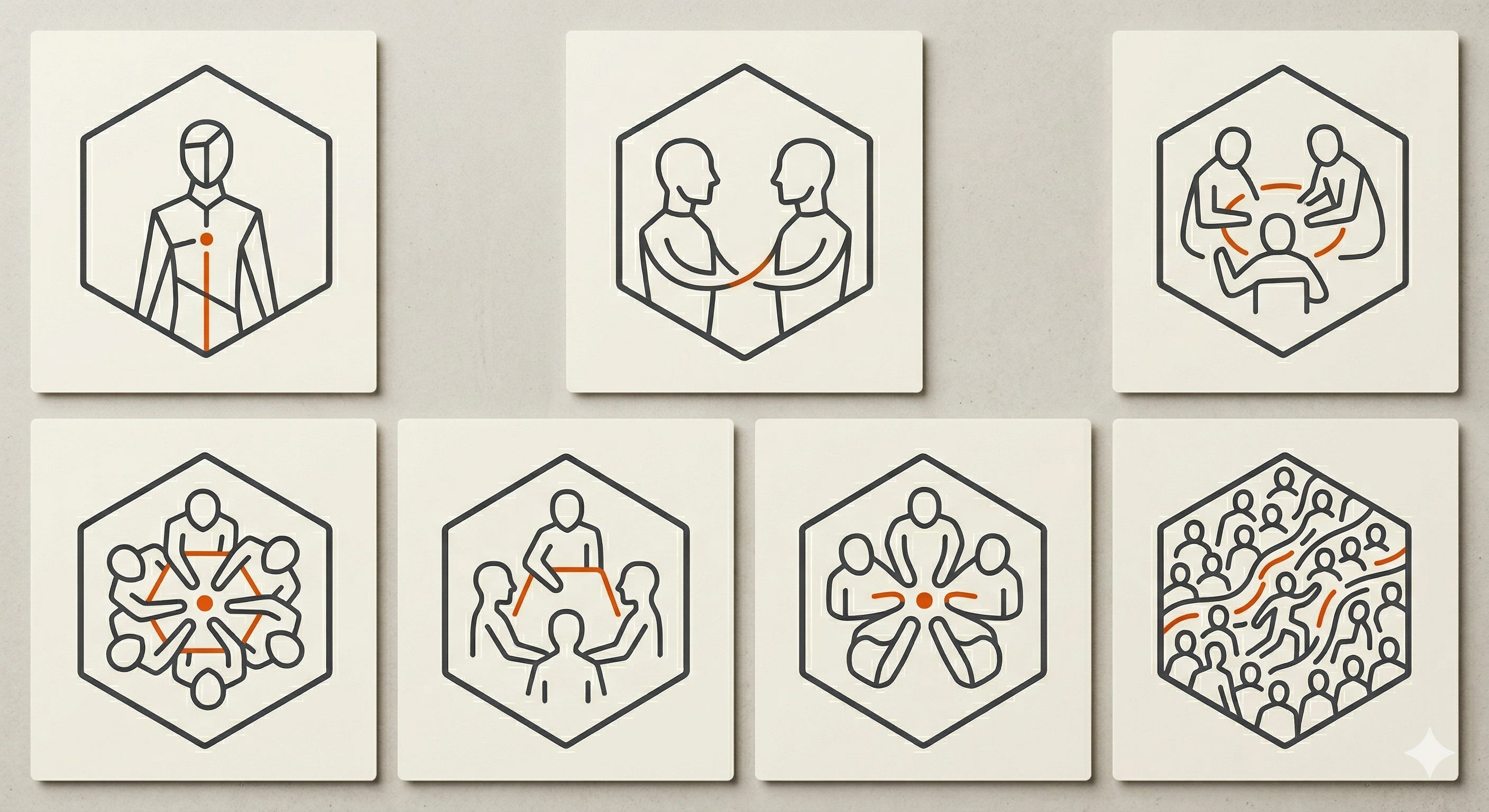
Individual Contributor
Partnerships (1-on-1)
Teams or Departments:
Small Teams (5 or fewer people)
Large Groups/Departments (6 or more people)
Executive Leadership Potential
Managerial Capabilities
When we look at Jobs’ Design, we can see that his ideal environments were (perhaps not surprisingly):
One-on-one partnerships
Small Teams
The framing here is always about where Jobs is designed to thrive (the double negative is intentional, for those keeping score).

Collaboration through Partnership
This is where Jobs worked best. Partnerships, particularly the ones that are 1:1, provided it was the correct and fitting person. In any good partnership, or any team formation for that matter, you sort of become greater than the sum of the parts, while at the same time something else converges.

In the specific case of Partnerships, it’s actually useful to use inversion to talk about the value of 1:1 here. What happens when you work alone when it’s not your ideal arrangement? Of course anyone can work in any environment, let’s be clear on that. The real question is whether it’s ideal, meaning how long is it sustainable, is it preferred, and does it bring out the best in you (and vice versa)? Those are the real questions, and why there is value in understanding the environments you work best in and with.
In tech, and before this Agentic AI craze, most of the work we had to do, particularly the technical parts, was so highly specialized that you were always working with others. The whole idea of teams is the norm in tech (as you know). So it’s actually hard to distill what a true Individual Contributor looks like, not just a Senior Dev on a pod, but truly the lone wolf. But suffice to say that even Jobs, who as CEO could’ve done most of it on his own (barring the tech know-how), found it fascinating to work with the other ‘Steve’ to realize his mission and vision.
On the way to founding Apple, he famously had a productive, yet at times tumultuous, relationship with Steve Wozniak. The two Steves’ achievements are undeniable. And in a few short weeks, Apple will celebrate its 50th birthday of its founding on April 1. But back in 1976, that partnership was instrumental and, I would say, brought out the best in each other.
When I examine the two Steves’ Design, we see something even more fascinating. Jobs works best in partnerships, helping bridge his mind to do his best work. Woz is quite happy to work alone and can do so for long periods. But Woz’s Design helps bridge Jobs’ Design. Remember, Strengths are made of two Traits. Jobs has the Strengths we covered in Part 1, but when Woz is around, Jobs is also able to, temporarily, carry the Strength of Discovery and the Strength of Inspiration. And if we were to unpack it a bit further, both of these translate to the Design of Succeeding Where Others Fail and the Design of the Creative Role Model.
So in this specific partnership, Jobs is helped by being able to do things more efficiently, both in thinking and feeling, and with Woz’s partnership specifically is able to bring out, in both of them, the ability to find success even in failure and to be the creative. In a nutshell, that has been Apple’s core since the very beginning.
Collaboration in Small Teams
Besides Partnerships, Jobs excels in well-chosen groups. I’ll probably start another series to go into team dynamics more later, but let’s focus on how he excels at working in small groups.

Besides the individual Strengths that Jobs possesses (discussed in Part 1), within a smaller group setting he also brings a different set of skills when it’s a group bigger than a partnership (ideally five people or fewer).
He brings four skills to the team at a group level:
Reliability
Commitment
Implementation
Accounting
There are 12 different types of skills that individuals bring to form teams. Steve has 4 of the 12. It’s less about the total number because the old adage describes it best: “the whole is greater than the sum of the parts”. In fact, here is Steve, waxing poetic on this exact thing and how he runs Apple AAPL 0.00%↑ like The Beatles:
“My model of business is The Beatles…they balanced each other. The total was greater than sum of the parts. Great things in business are never done by one person…they are done by a team of people. When The Beatles were together, they did truly innovative work. When they split up, they did good work but it was never the same.”


The 4 skills he brings feel more like adding to the matrix of the team, the fact that any small team becomes an entity unto itself and rows in unison (or not). I guess that’s why the same root word of an organism and organization is not by accident.
Another way to put it: in the context of a business team, your focus is on material success and business survival. So what you bring to the team matters at a team level, not just an individual one. As we talk through the Skills Jobs brings, it’ll probably become more apparent how finding people that complement you, and not over-concentrate on one particular Skill, is vital to each small team’s success.
Reliability

The typical connotation here is that reliability is about showing up, perhaps being on time. But from a BG5 perspective, it’s more about these:
Trust
Safety
Security
Those are the things Reliability brings, and the second-order effects of that are the ability to attract talent, retain them, and provide the team a sense of belonging. Think of this as the “glue” that brings people together and holds them long enough to get stuff done.
Perhaps the clearest evidence of Jobs bringing the Skill of Reliability to his team is how Jony Ive describes the design relationship at Apple over their fifteen-plus year partnership. Ive has spoken in multiple interviews about how Jobs created an unusual kind of protection around the Industrial Design group, shielding it from the short-term commercial pressures that typically compromise design work at large companies. The design team reported directly to Jobs rather than through the usual organizational hierarchy, and this arrangement sent an unmistakable signal to the broader Apple org: this group has top-level trust and security. That kind of structural backing is what Trust, Safety, and Security actually look like in practice.
Here’s Jony recounting just that:
Commitment

Mostly self-explanatory. This is the goal-oriented skill of setting an outcome and hitting the mark.
It also provides the necessary conditions by which everyone comes onto the same page.
The higher-order effects of staying committed means it engenders loyalty to the energy dynamics of the team and stabilizes that commitment for the good of the team and the outcomes. There is a pitfall of over-commitment and all the downsides that brings, but overall it’s a dedication to make the team work for the good of the business.
The Skill of Commitment and its dynamic showed up in the very inception of the iPod and its eventual launch in 2001. Even before the first prototype was shown to the team, Jobs framed the entire product in one sentence: “1,000 songs in your pocket”. This wasn’t just a tagline invented for the launch event. It was the commitment statement that oriented the whole product team around a single, measurable outcome. The team building the iPod knew what the “definition of done” was.
Just watch this short clip below from Tony Fadell who one of the fathers of the iPod. It brings out two important things. Jobs and Fadell were part of the same team and Jobs presence (and Skill as we’re learning) was to bring the Commitment to the team. It’s exactly the type of Commitment that Fadell recalls here: they had each others’ back:
“So he made that commitment to me and I made this commitment to him to build it [iPod]” —Tony Fadell
Implementation

Implementation here refers to a few aspects:
Taking the company’s core vision and actually implementing it.
Representing the raw, innovative, creative force that drives the manifestation into a product or service in the marketplace.
Let’s invert this. If this Skill is missing from the Small Team, what you might have is resources, a solid direction, even a great PR person, but missing the unique value proposition and the ability to actually create the thing you’ll sell.
Another way of thinking about this Skill is the ability to pivot as things change. Implementation is bringing it all together from vision to product and the ability to sell it to customers. So when things change in the marketplace, without this Skill you’re likely also not able to adapt creatively.
In 1979, Jobs visited Xerox PARC and saw an early demonstration of a graphical user interface (GUI), windows, icons, and a mouse. Xerox had it. They didn’t know what to do with it. Jobs did. He went back to Apple and immediately began driving his team to implement what he had seen, pushing the engineers to do what they said was technically impossible at the speed and quality required for a consumer product. The engineers on the LISA and later the Mac teams have been clear about how relentless this pressure was. Jobs didn’t invent the GUI. He implemented it, and the distinction matters: Implementation is the Skill of taking what exists in concept and forcing it through to a thing someone can actually hold, use, and buy.
The iPhone is perhaps the definitive Jobs Implementation story. The internal project, codenamed Project Purple, was by most accounts a near-impossible engineering challenge: a new touch interface, a new mobile OS, a new radio stack, and miniaturized hardware that didn’t yet exist in the form required, all converging into one product. Jobs reviewed prototypes personally and repeatedly rejected them until the feel matched the vision. The scroll inertia on the original iPhone, the way content glides and decelerates like a physical object, is one documented example of Jobs insisting on a specific implementation detail until his team figured out how to do it. Forstall, Ive, and others who worked closely on the iPhone have described the same dynamic: the bar wasn’t the technically feasible version. It was the version that felt right. And Jobs kept pushing until those two things became the same thing.
This is a longer clip but all about Project Purple (soon to be iPhone):
Accounting

Here, this Team Skill is what Jobs brings and is a skill not as a CPA, but accounting for what the org has and is doing. The Accounting Team Skill asks two key questions in the team and business:
Are we profitable, or are we just doing busy work?
Do we understand where the organization has been, and are we using that to our advantage, learning from our failures and successes?
When Jobs returned to Apple in 1997, the company was losing roughly a billion dollars a year and had over 350 products in its lineup, many of which were redundant, unprofitable, or both. One of Jobs’ first moves as interim CEO was to stand at a whiteboard, draw a two-by-two grid, and label the axes: consumer versus professional, desktop versus portable. Four quadrants. He told his team: these are the four products we’re going to make. Everything else got cut. This is the Accounting Skill operating at its most concentrated. The question “are we profitable or are we just doing busy work?” is hard to answer honestly when you’re inside a large organization with momentum in many directions. Jobs answered it by forcing the org to see itself clearly, using the simplest possible framework, and acting on what he saw.
Medium-length clip here, but if you watch it all you get the gist that Jobs was focused on knowing where Apple came from and also where it could win given it’s prospects so far. It was a pragmatic vision of “Accounting” what is left and how to get there:
If you’re ready to learn more about your own unique Personal Moat or about Human Design and how it can help your career, team, or business, feel free to reach out. I’m doing free consults focusing on those who, like me, are in tech. No pitch, just conversation if you feel like taking the next step.
This is part of The Personal Moat series. Below are the Part 3, 4 and 5 on Steve Jobs’ Ideal Working Arrangements, Pitfalls, Public Role, and Work Theme:
https://www.humandesignfortechworkers.com/p/personal-moat-steve-jobs-part-3