

It was 4:30 PM on a Friday. A calendar invite popped up for the last meeting of the week.
I was a Product Manager at a “unicorn” tech company. My colleague pulled up a slide deck that was scheduled for the Monday morning all-hands. The slide showed my department.
My team was being split in two. All the “A-players” were being moved to a new division. I was being assigned a legacy product and a new “experimental” team. Effectively, I was being asked to do 2.5 times the work with half the talent.
I had no say in this. I had zero time to prepare.
The Monday all-hands arrived. I was told to roll this out immediately. I was told to have a vision and goals for these two teams by the end of the day.
The result was predictable. It destroyed morale. Productivity cratered. Trust evaporated.
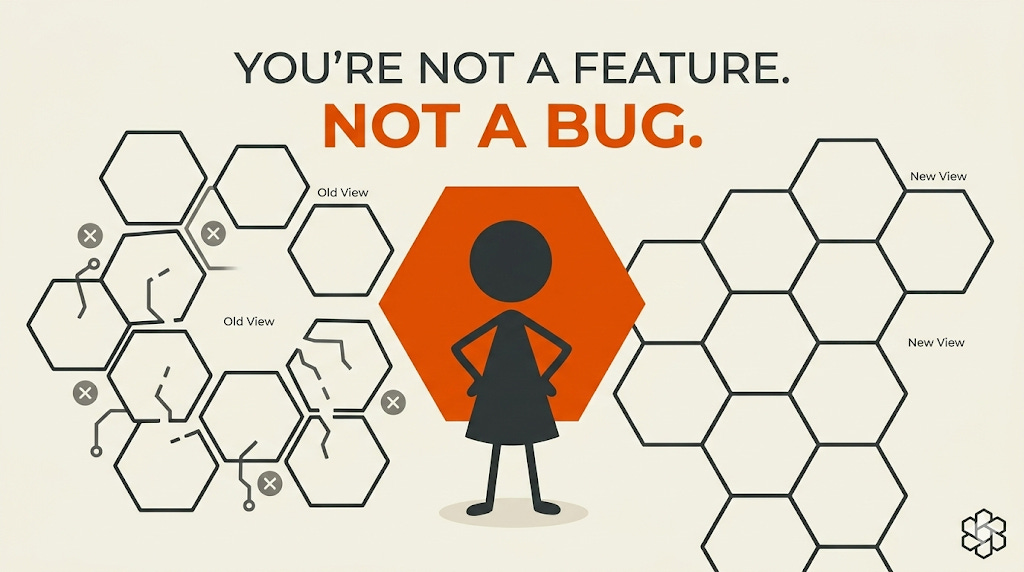
I can tell you that it did not have to be this way. But the biggest risk here wasn’t the bad management decision. It was my reaction to it.
I spent years thinking my friction with this system was a defect. I thought I was broken. I thought that if I just ran more regression tests on my behavior or patched my personality, I would finally fit.
Boy, was I incorrect.
The Risk Is Not AI. The Risk Is Being Generic. Homogenized.
In the tech industry, we are obsessed with bugs. If something does not work as expected, we call it broken. We try to fix it.
But you are not broken. You are functioning exactly as you were designed. The failure is the system that is trying to shove you into a template that was never built for you.
In 2015, fitting in was a survival strategy. You could grind your way to the middle. But we are looking down the barrel of the AGI era. In this new world, “experience” and “credentials” are depreciating assets.
The only asset that holds value now is alignment.
If you are an engineer trying to be a manager when you are built to be a specialist, you will burn out. If you are a founder trying to build consistent operational workflows when you are designed for innovation, you will fail.
You are treating your unique traits as bugs. They are actually your strongest features.
Consult the Source Code
I am an ex-engineer, ex-founder, and private investor. I have been in startups of 30 people and massive organizations of thousands. I spent years trying to sand down my edges.
It did not work because I was ignoring my Career Design.
In BG5 (Business Mechanics), we don’t look at personality tests or generic strengths. We look at your mechanics. We look at your Traits and Strengths. We look at whether you are here to build, to guide, or to initiate. And they are very unique to you.
Most of us are operating like a high-performance server that is being forced to act like a client-side script. It is inefficient. It causes overheating. Eventually, the system crashes.
Starting “Human Design for Tech Workers”
This Substack is for the outliers. It is for the pattern-matchers. It is for the ones who suspect that the “standard operating procedure” is actually the problem.
I am not here to offer you misery loves company. I am not here to rehash victimhood.
I am here to show you that your “misfit” status is actually a signal. It is data.
You might be a Classic Builder trying to force things to happen, instead of responding to what is needed. You might be an Advisor trying to do the work yourself, instead of guiding others to efficiency.
When you finally understand your differentiated unique mechanics, you stop trying to refactor yourself. You start building a system around how you are actually wired.
There is no Hotfix required
If you have spent years trying to debug yourself in tech and you have reached a point where the patch just isn’t holding, it is time to look at the documentation.
You are not a problem to fix. You are a feature to discover.
Consult the Source Code.
Interested to learn about your unique Career/Business Success Code Report, download yours today.
When you’re ready to do a 1:1 Consult on how to apply these to your career as you think about transition to or in and out of Tech, reach out below for a free consult!