

Teams are getting smaller. You’ve probably noticed.
The companies being built right now look nothing like what I was seeing five years ago even at the scrappiest startups. A solo operator with a handful of AI agents ships what used to take ten people.
Two founders and the right stack run what would’ve been a whole department. The math on team size just changed and it changed fast.
Because here’s what happens when the team shrinks to three or four people (or entities, if we’re being honest about the AI part). There’s nowhere to hide.
No org chart absorbing the gaps. No junior hire picking up whatever fell through the cracks. Every function that doesn’t get covered either lands on you or it just... doesn’t happen.
And you find out which one it was at the worst possible time.
The Mistake I Keep Seeing
Most founders building lean right now are hiring for skills and domain knowledge. Which makes sense on the surface because skills are easy to evaluate and they look great on a resume and LinkedIn has trained all of us to think in terms of “can this person do the thing.”
But skills and domain knowledge are what you’ve learned. And in a founding team where everyone is wearing four hats and running on caffeine and conviction, what matters more is something harder to put on a job posting: what are you actually wired to hold?
I think that’s a different question than most people are asking. And I think it explains a lot of the quiet grinding that happens on teams that look like they should be working but somehow aren’t.
Where BG5 Gets Interesting Here
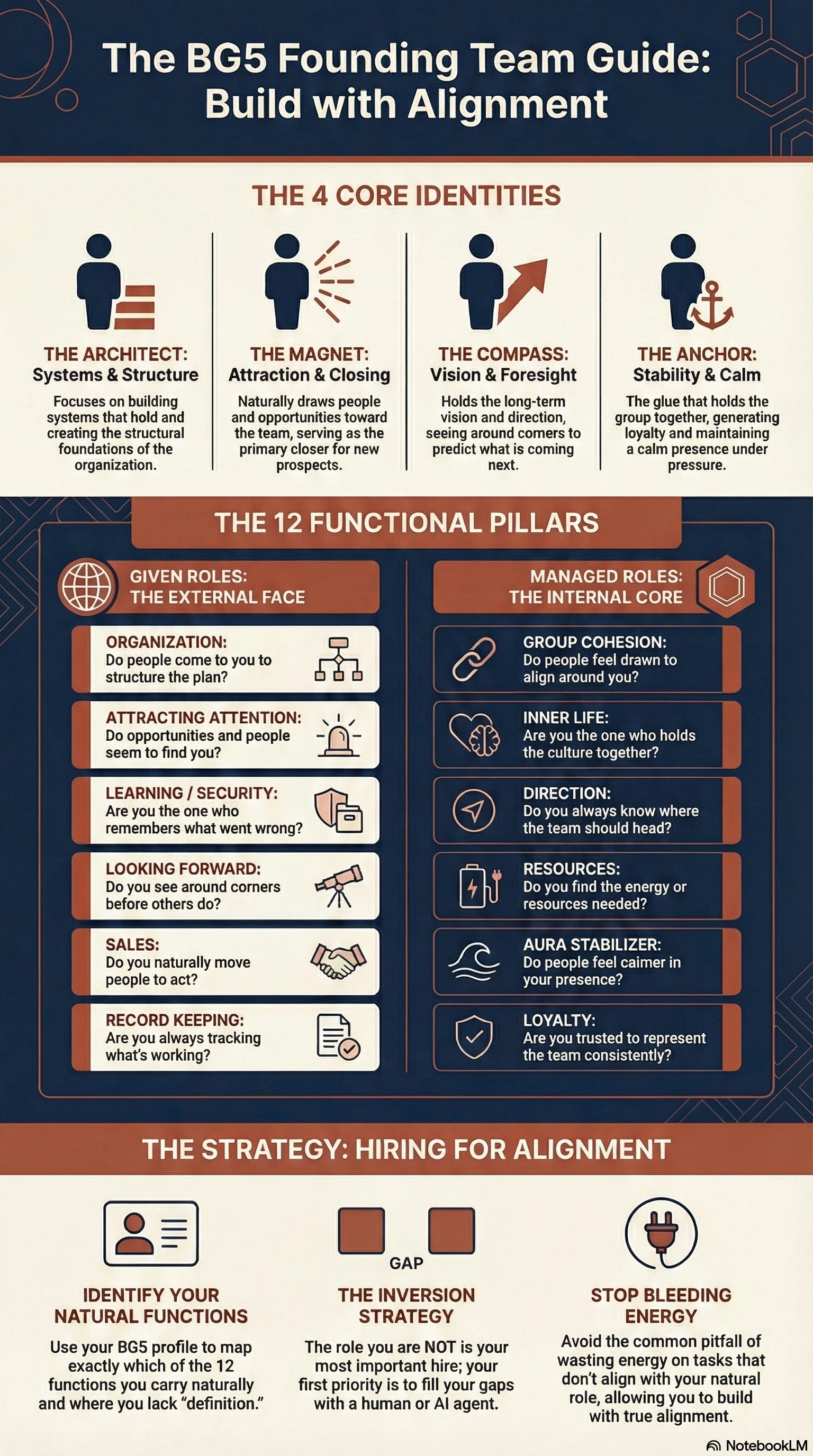
BG5 has this model for small groups, 3 to 5 people working together to build something. It maps twelve functions that every healthy team needs covered. Six of them are about how the team shows up externally (things like organization, getting attention, looking forward, sales) and six are about how the team holds together from the inside (direction, generating resources, the internal culture, keeping people pulled in the same direction).

Some of these you carry naturally. Some you really don’t. And the thing I keep coming back to with this framework is that carrying them all was never the point (which is a relief honestly because I’ve definitely tried to carry them all and it went about as well as you’d expect).
The functions you don’t carry? Those are your first hire.
Why This Matters More Now
When a Founding Team was eight or ten people, you had buffer or too many cooks in the kitchen. Someone was probably covering for someone else’s gap without either of them knowing it. The org chart papered over a lot.
At three people and two AI agents? Every decision about who holds what is structural. There’s no slack in the system. The team either has its functions covered or it finds out the hard way that it doesn’t.
I think the founders figuring this out early, building around wiring instead of just skill inventories, are going to have a real edge. And I think everyone else is going to spend a lot of time in that frustrating zone where the team should be working but something is off and nobody can quite name what it is.
What’s Coming
Over the next few posts I’m going to map each of the twelve functions in detail. What they look like when they’re present, what breaks when they’re absent, and how to think about covering them when your “hire” might be a human, an agent, or some combination that didn’t exist two years ago.
But before any of that is useful you need to know which ones you carry. And maybe more importantly which ones you’ve been trying to carry that were never yours.
Here’s a quick overview of how you can start asking yourself which ones you slot into more and also finding where there are potential gaps:
And if you want to talk through what any of this means for the team you’re building or the one you’re on, I do free consults. Reach out below.