

The background frequency of the tech industry has stopped humming. Can you feel it!?
In 2022, if you could ship code or manage a backlog, you were royalty. Recruiters were sliding into DMs with offers. I certainly felt that during the peak. I have the LinkedIn inbox history to show for it.
Today, in 2026, the silence is deafening.
Here’s someone with an advanced degree in Machine Learning. Look at their experience in trying to find a job in the tech industry:
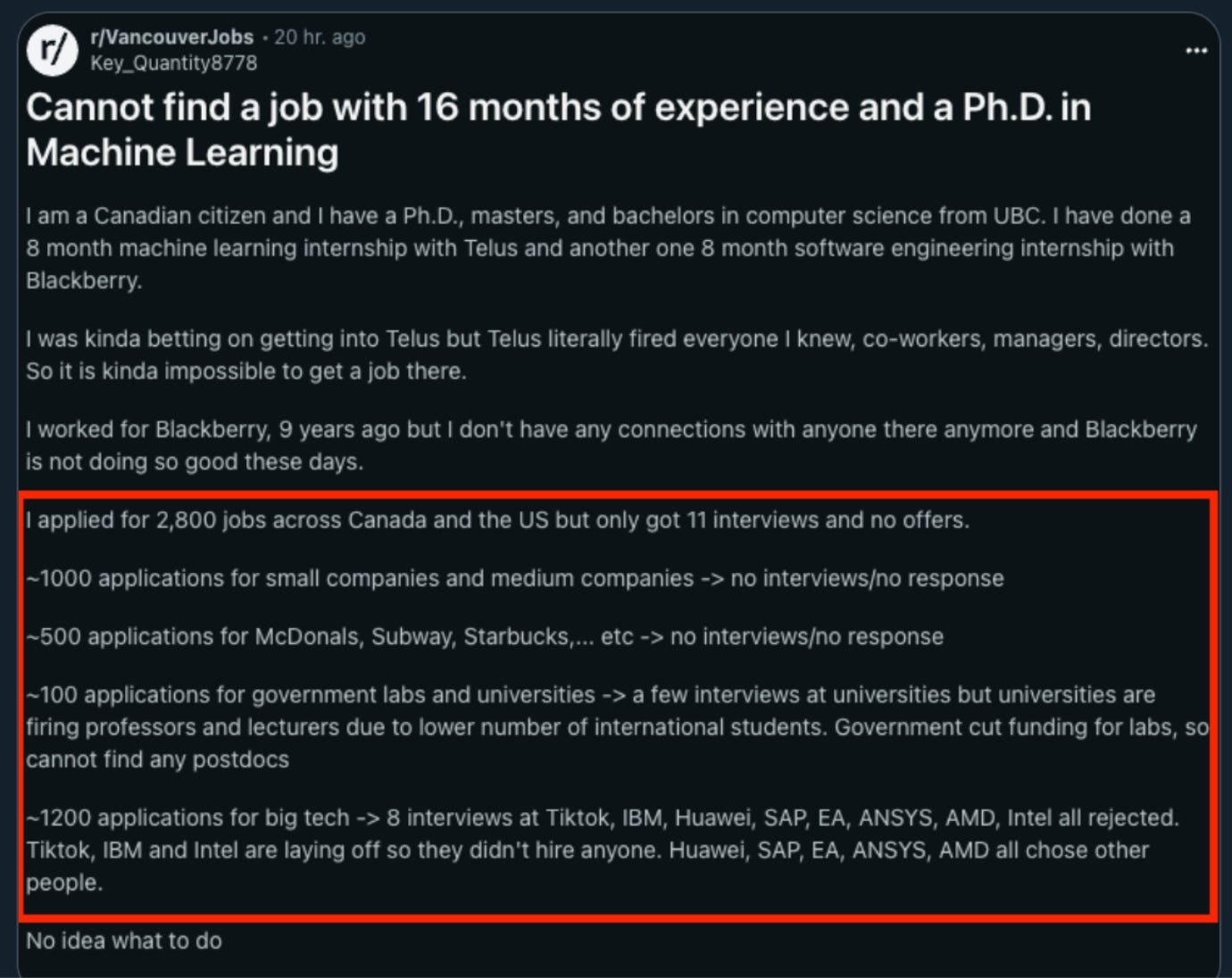
I am not here to be a pessimist. I am here to report the structural change. We are witnessing the most aggressive depreciation of human capital especially those of us in tech since the dawn of tech. And if you are attempting to “upskill” your way out of this by learning a new framework, you are solving for the wrong user.
The Litmus Test Has Changed
Let’s look at the hard data. I hope this is less fear-mongering but more just spinning up an analytics dashboard.
The Goldman Sachs Reality (Financial Services): A task that once took a six-person team of investment bankers weeks of sleepless nights is now done by GenAI in minutes, at 95% quality.
The Shopify Standard (eCommerce): The new threshold for hiring is simple. Can an AI do this? If yes, the role doesn’t exist.
The Tyler Perry Pivot (Media): The creative industries likely seem to be early innings and is the least safe. Mogul Tyler Perry officially halted an $800 million studio expansion in Atlanta specifically after witnessing the capabilities of OpenAI’s Sora. He realized he no longer needed to build so many physical sets or hire as many specialized crew members.
The Amazon Shift (Big Tech): Amazon Web Services (AWS) cut thousands of roles in sales, marketing, and global services. They were not just cutting costs. They were “reprioritizing” to focus resources on their AI capabilities. The message is that software is eating the sales team.
The McKinsey Forecast (Strategy): The firm known for defining corporate strategy estimates that current generative AI has the potential to automate work activities that absorb 60 to 70 percent of employees’ time today.
I Used to Engineer Complex System to Support Humans. Now the Machine Wants You Out.
I am an Industrial and Human Factors Engineer.
My early career was dedicated to engineering complex systems at nuclear power plants where the human was the most critical variable (and also the most variable). My job was to ensure the human could function at their best. We let the human do what they do well, and left the computer to do what it does well.
In engineering, we call this Function Allocation.
I look at the current Tech ecosystem and I see we are in a brave new world.
Since the last industrial revolution (and aggressively since 2000), we have been forcing humans to act like computers, even while we engineered better products with superior user experience. However, those of us in the “sausage factor” making the software and building the code, we were grinding out code, working the machine to produce the widget, optimizing for velocity, and treating burnout as a badge of honor.
Exhibit A: The Cult of Agile
The clearest example of this failure, forcing humans to act like machines, is what has happened to Agile.
Back in 2017, I was working as a Product Manager at a big bank. We were going through the standard Agile transformation. The instructor from the Scrum Alliance said something to me that gave away the entire game.
He said, “The Agile Manifesto only works when everyone on the team is an A-player.” Then he laughed and said, “Remember rule number one.”
He was right. The original authors of the Agile Manifesto were rebels. They prioritized conversations over documentation. But look at your team today.
We have taken a philosophy about human interaction and turned it into a data-entry job about how complete your JIRA ticket is or not. We did this because like all well-intended things, we’ve ended up taking it too far and sowed the seeds of a homogenized system. After all, no one got fired for buying Atlassian software and telling people to run “sprints”, use the buzzwords and hold the stand-ups.
And the data proves this “human-as-computer” model is failing. A recent study of software engineers in the UK revealed that projects adopting these rigid “Agile” practices had a 268% higher failure rate compared to those that did not.
Fast-forward to today: AI is Eating Labor
You don’t have to take my word for it. The smartest money in Silicon Valley is betting on this exact shift.
In a January 2026 discussion on the state of the industry, Andreessen Horowitz (a16z) General Partner Alex Rampell explicitly categorized the new investment theme as “Software Eating Labor.”
The market for “labor” is astronomically larger than the market for “software.” For decades, we bought software to help humans work. Now, VCs are funding software to be the labor.
But there was another key takeaway from their discussion: The Walled Garden.
They noted that for an AI company (or legacy tech company) to survive, it needs a “Moat.” A proprietary data set that no one else has. If you don’t have a moat, you are just a commodity.
This is your hint.
You cannot compete with AI on “processing” or labor. You can only compete if you have a “Moat.”
From Software Eating the World to Human-AI Systems of Intelligence
If the cult of Agile in the 2010s ironically made your job less “human” by putting yourself as a cog in the machine, then there is a massive opportunity with AI as a lever.
Let AI do what it does best and allow you to do what you uniquely do best. That’s optimizing for the system, not just the parts.
And no matter where AI evolves too, it’s the system and the synergistic effects of the system that will prevail.
We can all that Human-AI Systems of Intelligence.
In that world, where technical skills become a commodity and that the bar for embedding oneself into these Systems of Intelligence, your leverage is to lean into knowing what are you consistent strengths and how to tap into your Creativity.
In Human Design for Careers and Business (BG5), we call those unique parts of you your Success Codes. It is your personal Walled Garden or personal moat.
The “system error” most tech workers are experiencing right now comes from trying to operate like a computer. You try to process faster. You try to output more. You ignore your internal signals to try to outrun the exponential velocity of AI/AGI.
But you cannot out-process a processor.
The only asset you have that cannot be automated is your unique Design.
Your Traits: These are not skills you learn on a weekend. These are the fixed, reliable nuances of your personality.
Your Strengths: This is your consistent life-force energy. It defines how you handle stress, how you handle pressure, and where your true talents lie.
Your Public Role: AI does not have a reputation or a vibe. You do.
Are you operating as a depreciating asset or a differentiated human?
I help tech individual contributors, managers, leaders and founders decode their own unique Success Codes to stop competing with the machine and start finding how sets you apart.
Interested to learn about your unique Career/Business Success Code Report, download yours today.
When you’re ready to do a 1:1 Consult on how to apply these to your career as you think about transition to or in and out of Tech, reach out below for a free consult!
I'm in a position that is much harder to replace with AI, and yet I'm still worried. I don't think my job will be taken, I see it consolidating the industries. Software companies are going to have a brutal decade as AI replaces more and more of their core functionality.
Totally agree with your premise though; ATMs gave tellers the chance to lean in on the unique human characteristics and outsource the boring stuff to a machine. I think many jobs more generally are going to go through this transformation, and the ones that rely on no human uniqueness are going to be the ones most threatened.