

Before I ever heard the words “Wait to Respond” and before I knew anything about BG5 or Human Design, I built a bootstrapped SaaS business from zero. It became profitable. It worked beautifully.

What I think happened, and this only became clear to me much later, is that I stumbled into a process that happened to match the way I’m actually wired. I was operating in alignment with my Design before I had any language for what that meant.
This is that story.
The Itch
Picture this: it’s 2012.
I’m a Senior Engineer at a consulting firm, working a multi-billion dollar project. The money is good. The work is stable. On paper, everything is fine.
But I’d look around the office floor and see Senior Engineers (senior in title, senior in age) who had spent their entire careers in this one specialized field. And something in me knew: I was watching my own future if I stayed. Every additional year was digging the trench deeper.
I didn’t want that.
So I started looking. I didn’t know for what exactly, I just knew the restlessness was telling me something and I should probably listen to it rather than drown it out with another project milestone.
I started listening to podcasts on my commute, mostly people talking about building businesses and making money outside of a salary. I went through a lot of them. But one episode stuck.
A SaaS founder came on and talked about how he’d bootstrapped a B2B software company into millions in ARR for an industry he knew almost nothing about when he started. His whole approach was: spend enough time with people in a niche, understand their pain, and build what they’re telling you they need.
And I remember thinking, wait, that’s what I already do. That’s literally what I do as an engineer. Crowdsource information from users, understand how they work, reduce friction. He wasn’t describing something foreign. He was describing my job pointed at a different problem.
I signed up for his course within days.
400 Conversations
The niche I chose was Financial Planners and Advisors, specifically Fee-Only Advisors. I knew nothing about finance but I was curious about the space and I had a method.
I picked up the phone. I sent emails. I used LinkedIn and industry forums. For months I took calls on my lunch break and after work hours, talking to business owners in this niche. Not pitching anything. Just listening.
By the time I was ready to make my first offer, I had done over 400 of those conversations.
Four hundred.
Not because I had a quota to hit. Because every conversation was giving me something, a signal, a pattern, a piece of the puzzle. I kept going because the responses kept pulling me forward, brick by brick, until the picture became clear enough to act on.

I found a specific pain point. Made an offer. Asked for pre-payment (up to a year of the SaaS fee upfront) as seed money to fund the first version.
You never forget your first sale. Then a plateau. Then five more over the next month. I had enough to hire a team.
The first team didn’t work out. I rehired. Got an MVP out in four months. Kept building. Kept taking calls. Kept responding to what I was learning.
Nine months later the thing was profitable.
What I Think I See Now
I’ve been studying Human Design and BG5 for a while now and I want to take a second to explain what those actually are, because I realize I keep saying the words like everyone already knows.
Human Design is a system that maps how you’re individually wired to operate. How you make decisions, how you process energy, what kind of work sustains you versus what drains you over time. Think of it like a user manual for yourself (except nobody gave it to you when you shipped, which feels like a design oversight honestly). It pulls from a few different systems and I know that sounds like it could go sideways fast, but the thing that got me was how specific it is. It’s not “you’re an introvert” or “you’re a blue personality.” It’s granular enough to explain why two people with the same job title and same skills can have completely different experiences doing the same work.
BG5 is the business application of Human Design. Same underlying system, but focused on how you show up in work contexts, in teams, in careers. It’s the lens I use because I came to this from the work side, not the spiritual side. I was trying to understand why some roles felt like swimming downstream and others felt like I was dragging a piano up a hill, and BG5 gave me the most specific answer I’d found.
So when I look back at that whole season of building the SaaS, I think I can see my design running underneath the entire thing.
In BG5 I’m what’s called an Express Builder. The core mechanic is response. I don’t operate well when I’m initiating from scratch, pushing something into existence through sheer willpower. I operate well when something shows up, I have a gut reaction to it, and I move on that reaction. The podcast wasn’t something I went hunting for. The course wasn’t a calculated strategic move. They showed up, something clicked, and I moved. That’s what correct operation looks like for my type (even though I had no idea at the time that “my type” was a thing).
The 400 conversations worked the same way. I wasn’t projecting what I thought people needed. I wasn’t assuming. I was just asking what was hard and building from whatever they told me. Every call was a response to the last one.
I also work better when there’s a network around me, other people going through the same thing, a cohort to think with. The course gave me that too. Accountability, shared progress, borrowed expertise. I didn’t go looking to build that structure. It was already there and I just showed up for it.
At no point in that process did I feel the drain that comes from forcing something. There was plenty of friction (a team that didn’t work out, months before the first sale, technical problems I wasn’t equipped for). But underneath it all, the work kept giving me energy back instead of taking it. I didn’t have a word for that then. Now I’d call it operating in alignment with your design. Which is a fancy way of saying: the process fit me, even though I picked it by accident.
Something to Sit With
Here’s what I keep coming back to. I got lucky. The process I stumbled into happened to match my wiring. But what if it hadn’t? I’d probably still be out there trying someone else’s playbook, grinding harder than I needed to, wondering why the thing that worked for that podcast guy wasn’t working for me.
What if you could skip the stumbling part? What if instead of trying every approach until one accidentally fits, you started with a map of how you’re actually designed to operate and worked backward from there?
That’s the question BG5 helped me answer in retrospect. I think it’s more interesting as a question you ask on the front end.
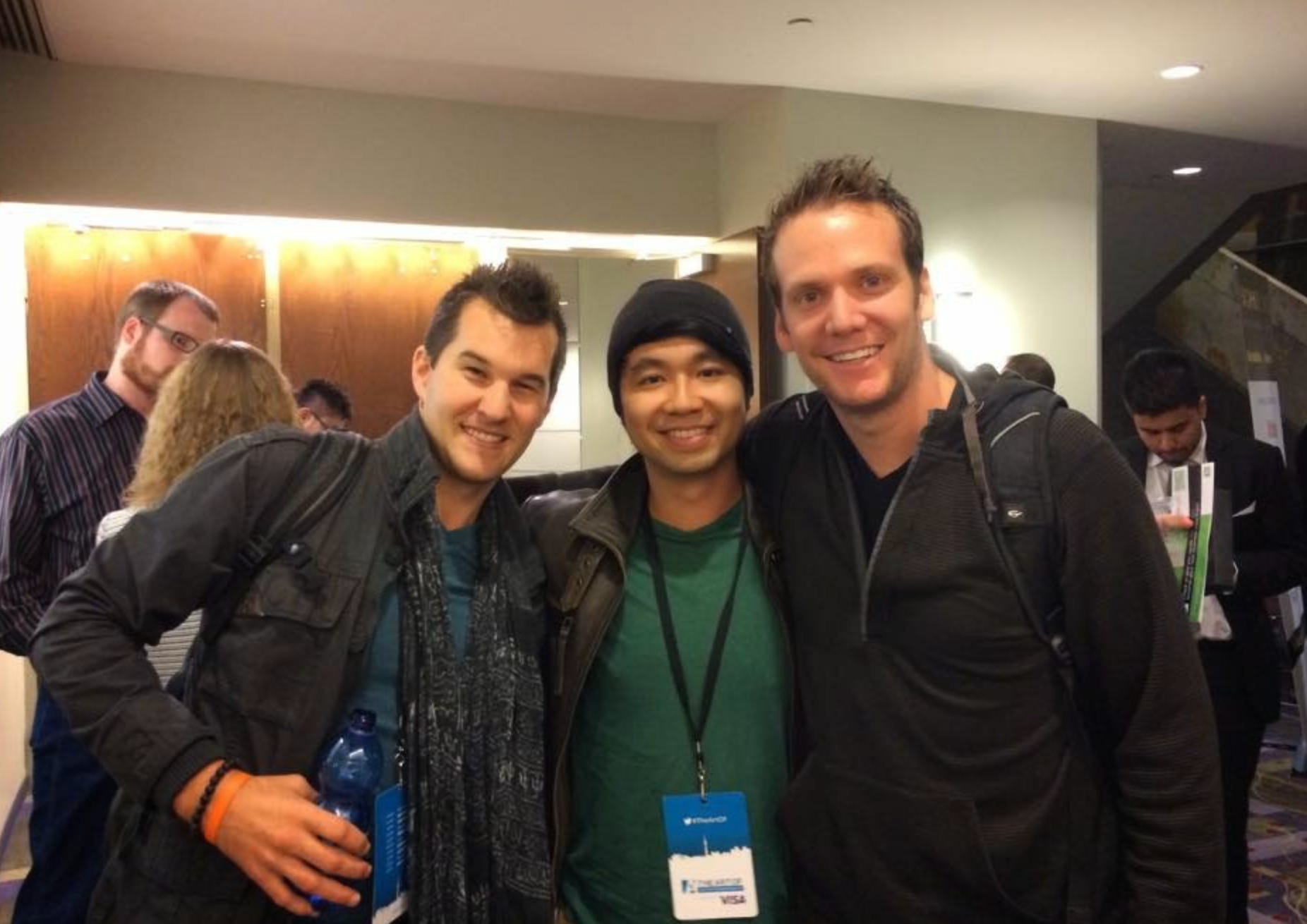
This was me with the Co-founders of the course:
If you’re curious what your design actually says about how you work best, the BG5 Career Success Code Report is a good starting point. It maps your wiring, your type, your decision-making style, the stuff that was probably running underneath your best work all along (and your worst). Grab yours and see what resonates.
And if you want to talk through what any of it means for the specific situation you’re in right now, I do free consults. No pitch, just a conversation. Reach out below: